
AI Lead Enrichment in 2026: How to Qualify & Score Prospects Without Third-Party Token Fees
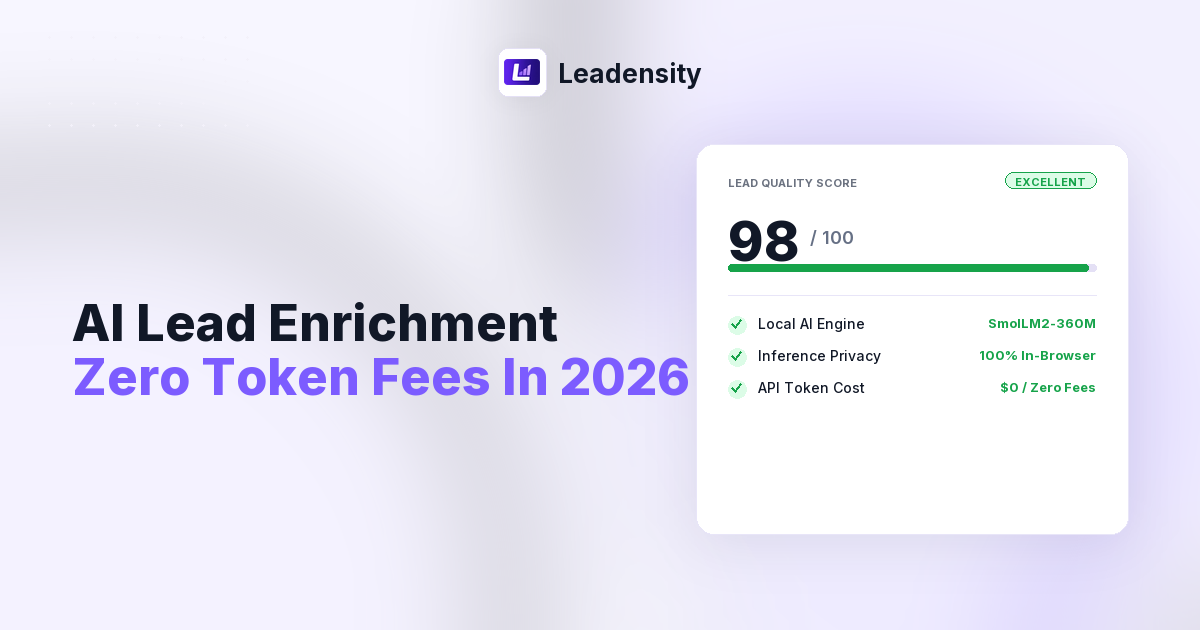
AI lead enrichment has become the cornerstone of high-velocity outbound sales and modern revenue operations. In 2026, raw lead lists containing basic contact fields like first names and unverified corporate email addresses are practically useless. To stand out in saturated executive inboxes, prevent high bounce rates, and generate predictable pipeline, sales teams must enrich prospect records with actionable firmographic intelligence, corporate infrastructure health, verified software stack signatures, and personalized commercial hooks. However, traditional AI enrichment workflows suffer from a crippling structural flaw: they rely on commercial cloud language model APIs that charge recurring per-token fees. When marketing and sales development teams attempt to qualify databases of 20,000, 50,000, or 100,000 prospect records, external API invoices quickly escalate into thousands of dollars per month. The next evolution of B2B intelligence solves this economic bottleneck by executing neural network inference locally inside the user web browser. By pairing client-side local language models with automated 10-point technical verification, high-growth organizations can qualify, score, and enrich massive lead lists instantly with exactly zero dollars in third-party token expenses.
Table of Contents
- 1. What Is Lead Enrichment? (The Spectrum from Data Hygiene to Intelligence)
- 2. The Token Pricing Trap: Why Cloud LLM Enrichment Breaks Unit Economics
- 3. The In-Browser AI Revolution: WebGPU, WASM, and Transformers.js
- 4. Architecture Deep Dive: How SmolLM2-360M-Instruct Runs on Client Hardware
- 5. The 4 Essential Dimensions of Modern B2B Lead Enrichment
- 6. Automated Tech Stack Fingerprinting: Uncovering Competitor & Stack Signals
- 7. Algorithmic Lead Scoring (0–100): Turning Raw Data into Prioritized Tiers
- 8. How Leadensity Unites Technical Verification with Local AI Synthesis
- 9. The SDR Playbook: Converting Enriched Signals into High-Reply Outbound Copy
- 10. High-Volume Processing Without Server Timeouts (Browser Micro-Batching)
- 11. Developer Integration: REST APIs, Webhooks, and Waterfall Architecture
- 12. Comparison Matrix: Cloud AI Scrapers vs. Legacy Tools vs. Leadensity
- 13. Frequently Asked Questions (FAQ)
- 14. Final Verdict and Strategic Implementation Roadmap
1. What Is Lead Enrichment? (The Spectrum from Data Hygiene to Intelligence)
Lead enrichment is the automated process of taking minimal, incomplete prospect records (such as an email address, a company domain, or a job title) and appending verified contextual data points to construct a complete, 360-degree commercial profile. In the early days of B2B sales automation, enrichment was largely synonymous with basic demographic lookups: appending a city, state, or standard SIC industry classification from static databases. In 2026, lead enrichment has evolved into a sophisticated, multi-tiered discipline that spans three distinct layers of operational intelligence:
- Layer 1: Technical & Deliverability Hygiene: Validating that the prospect domain possesses active DNS MX records, compliant SPF/DKIM/DMARC authentication, a live web server returning HTTP 200 OK, a valid SSL/TLS certificate, and a reachable SMTP socket that does not bounce or trigger spam traps.
- Layer 2: Firmographic & Technographic Fingerprinting: Detecting underlying technology stacks utilized by the prospect organization (e.g., e-commerce platforms, payment gateways, analytics providers, customer relationship management suites, and marketing automation tools) alongside estimated employee headcount and revenue brackets.
- Layer 3: AI Cognitive Synthesis & Pain Point Extraction: Utilizing artificial intelligence to read company website metadata, product positioning statements, and recent corporate announcements to synthesize what the company does, evaluate Ideal Customer Profile (ICP) fit, and generate tailored sales outreach angles.
Without Layers 1 and 2, AI-generated sales copy fails because messages are sent to dead domains or inaccurate buyer personas. Without Layer 3, sales development representatives are forced to spend 15 to 20 minutes manually browsing corporate websites before drafting a single outbound email. True modern lead enrichment automates all three layers simultaneously, providing sales teams with verified, contextualized, and prioritized prospect records ready for immediate pipeline conversion.
2. The Token Pricing Trap: Why Cloud LLM Enrichment Breaks Unit Economics
Over the past three years, the rise of commercial large language models (LLMs) such as OpenAI GPT-4, Anthropic Claude, and Google Gemini sparked a wave of “AI enrichment” tools. These applications promised to automate lead qualification by scraping prospect websites, feeding raw HTML dumps into an external API, and prompting the model to summarize company offerings and draft cold pitches. However, revenue leaders quickly encountered an unsustainable economic reality: the token pricing trap.
Consider the mathematical unit economics of using cloud-hosted LLM APIs to enrich a standard mid-market outbound lead database:
Cost Breakdown: Enriching 50,000 Prospect Records via Cloud LLM APIs
- Raw Context Input per Lead: Scraped homepage HTML, meta tags, about page text, and lead title ≈ 2,500 input tokens.
- System Prompt & Few-Shot Instruction: ICP scoring criteria, schema definitions, and guardrails ≈ 800 tokens.
- Structured JSON Output per Lead: Executive summary, tech stack mapping, ICP grade, and sales hooks ≈ 400 output tokens.
- Total Tokens per Single Lead: ~3,700 tokens.
- Batch Total for 50,000 Leads: 185,000,000 tokens (185 Million Tokens).
- Direct API Incurred Cost (at standard commercial model rates of $3/M input + $15/M output): $990.00 to $1,450.00 per single list run.
When SDR teams refresh databases monthly or growth agencies manage client pipelines containing hundreds of thousands of leads, cloud API bills rapidly surpass software subscription costs. Furthermore, cloud APIs introduce severe latency bottlenecks (often 1.5 to 4 seconds per HTTP API call), strict per-minute rate limits (TPM/RPM throttles), and grave data privacy compliance issues when unencrypted employee contact records are shipped to external commercial model providers. For B2B organizations seeking scalable margins, cloud token billing represents an outdated architectural model.
3. The In-Browser AI Revolution: WebGPU, WASM, and Transformers.js
The breakthrough that completely eliminates recurring token costs is client-side in-browser neural network execution. Over the past 18 months, three foundational web technologies converged to transform modern web browsers from passive document viewers into high-performance neural computing environments:
1. WebGPU (Hardware-Accelerated Compute Shaders)
WebGPU is the modern W3C standard that provides web applications with direct, low-level access to the client device physical Graphics Processing Unit (GPU). Unlike legacy WebGL, which was constrained to rendering graphics triangles, WebGPU exposes general compute shaders. This allows matrix multiplication algorithms—the core mathematical operation powering transformer attention heads—to execute directly on local GPU cores (Apple Silicon M-series, Nvidia RTX, AMD Radeon, or Intel Iris) with near-native execution speed.
2. WebAssembly (WASM with SIMD Vector Extensions)
For machines without dedicated discrete GPUs, WebAssembly (WASM) enables compiled binary execution in the browser thread at near-assembly performance. With 128-bit SIMD (Single Instruction, Multiple Data) optimizations and multi-threaded web workers, WASM processes quantized neural tensor math efficiently across standard CPU cores, ensuring universal device compatibility.
3. Transformers.js v3 & ONNX Runtime Web
Developed by Hugging Face, Transformers.js allows state-of-the-art pretrained models to be loaded and run entirely inside JavaScript engines without an intermediate Python server. Using 4-bit and 8-bit quantization (INT4/INT8), full instruction-tuned language models can be compressed to under 250 megabytes, downloaded once into browser CacheStorage, and run indefinitely offline.
By leveraging this stack, Leadensity shifts AI compute from centralized, billable cloud servers directly to the client browser. The consequence for SaaS operators and sales teams is profound: unlimited lead enrichment, zero API rate limits, complete enterprise data confidentiality, and $0.00 in per-token expenses.
4. Architecture Deep Dive: How SmolLM2-360M-Instruct Runs on Client Hardware
To deliver instantaneous enrichment without freezing user laptops, selecting the correct neural network architecture is critical. Massive 70-billion-parameter foundation models are fundamentally ill-suited for edge deployment. Instead, Leadensity integrates SmolLM2-360M-Instruct, a specialized compact language model developed by Hugging Face and trained on over 4 trillion tokens of curated synthetic reasoning data, code, and academic literature.
Despite possessing only 360 million parameters, SmolLM2-360M outperforms older 3-billion-parameter models on structured entity extraction, text classification, and JSON formatting benchmarks. In Leadensity, the model lifecycle executes through an optimized browser worker pipeline:
// Leadensity In-Browser Neural Pipeline (Conceptual Architecture)
import { pipeline, env } from '@huggingface/transformers';

// 1. Configure local browser hardware acceleration
env.backends.onnx.wasm.simd = true;
env.backends.onnx.wasm.numThreads = navigator.hardwareConcurrency || 4;

// 2. Initialize quantized local model pipeline via WebGPU
const classifier = await pipeline(
  'text-generation',
  'HuggingFaceTB/SmolLM2-360M-Instruct',
  {
    device: 'webgpu', // Fallback to 'wasm' if WebGPU is unvailable
    dtype: 'q4',      // 4-bit INT4 quantization (~220MB memory footprint)
  }
);

// 3. Structured Prospect Context & Prompt Payload
const prompt = `<|im_start|>system
You are a B2B sales intelligence engine. Analyze the prospect below and output valid JSON only:
{"summary": "...", "icp_score": 0-100, "pitch_hook": "..."}<|im_end|>
<|im_start|>user
Company: Acme Cloud Solutions
Website: acmecloud.io (HTTP 200, Valid SSL, Stripe + HubSpot detected)
Title: VP of Engineering
Name: Alex Carter<|im_end|>
<|im_start|>assistant
`;

// 4. Client-side local inference (Average latency: 120ms - 280ms)
const result = await classifier(prompt, { max_new_tokens: 180, temperature: 0.2 });
Because inference executes inside a dedicated Web Worker, your sales reps experience a buttery-smooth 60 FPS user interface while thousands of prospect rows are synthesized in the background. The model runs locally on the sales rep machine, completely private and isolated from external tracking.
5. The 4 Essential Dimensions of Modern B2B Lead Enrichment
Achieving predictable outbound pipeline requires evaluating prospects across four interconnected dimensions. Enriching only one or two dimensions while ignoring the others leaves critical blind spots that lead to bounced emails or irrelevant sales conversations:
6. Automated Tech Stack Fingerprinting: Uncovering Competitor & Stack Signals
Technographic data is one of the highest-converting signals in B2B sales development. If your product is a billing reconciliation platform that integrates directly with Stripe and QuickBooks, reaching out to a company running custom legacy invoicing is an uphill battle. Conversely, reaching out to a company where Leadensity has verified an active Stripe integration and HubSpot CRM allows your SDRs to open conversations with immediate, highly relevant value propositions.
Leadensity executes non-intrusive technographic fingerprinting by analyzing passive web signatures during the domain health verification phase:
- HTTP Header Signatures: Inspecting
Server,X-Powered-By, and caching headers to identify cloud infrastructure (AWS CloudFront, Cloudflare, Fastly, Vercel). - DOM Script & Resource Footprints: Identifying client-side tracking scripts, tag managers, analytics pixels (Google Analytics 4, Segment, Mixpanel), and customer chat widgets (Intercom, Drift, Crisp).
- DNS Service Configurations: Identifying enterprise mail infrastructure (Google Workspace, Microsoft 365, Mimecast) and security layers through TXT, MX, and CNAME mappings.
- Payment & Checkout Gateways: Detecting checkout tokens and script endpoints (Stripe.js, PayPal SDK, Shopify Pay) on commercial corporate domains.
These detected signatures are instantly appended to each lead record and passed directly into the local AI reasoning prompt, ensuring every sales pitch angle generated reflects the exact technological reality of the prospect organization.
7. Algorithmic Lead Scoring (0–100): Turning Raw Data into Prioritized Tiers
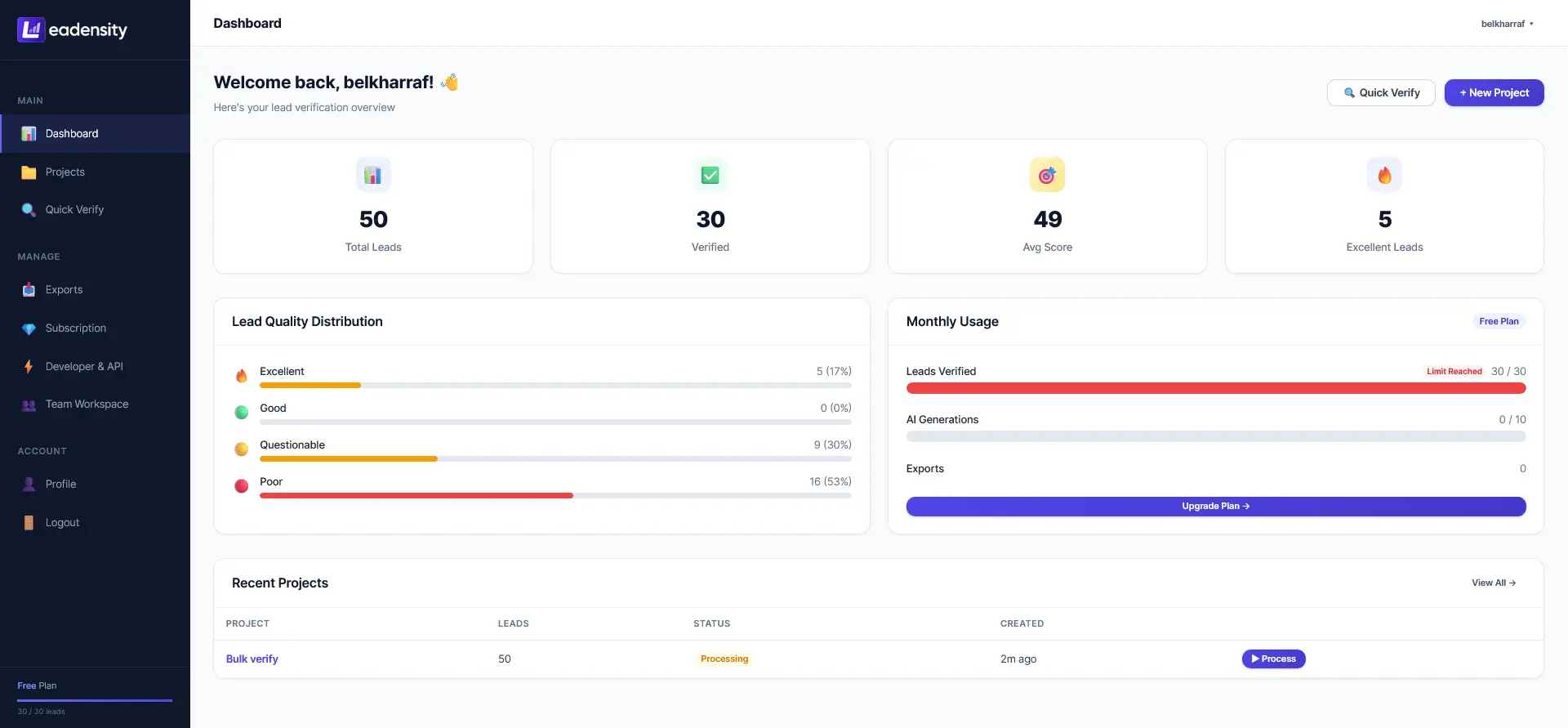
Enrichment data is only valuable if sales representatives know how to act upon it instantly. When an SDR looks at a spreadsheet of 2,000 leads, they should not have to manually cross-reference twenty separate data columns. Leadensity consolidates all technical, domain, technographic, and AI signals into an objective, weighted 0–100 Lead Quality Score:
Characteristics: Direct SMTP handshake confirmed, active website, valid SSL, mature domain (>1 year), key tech stack verified, AI confirms high ICP fit.
Action: Priority enrollment into primary multichannel sequences (Email + LinkedIn + Phone).
Characteristics: Verified deliverable or safe catch-all, live website, minor missing technographic signals, standard ICP compatibility.
Action: Safe for automated bulk cold email sequencing via warmed secondary domains.
Characteristics: Toxic catch-all, non-resolving web server, expired SSL certificate, disposable domain, or low AI relevancy score.
Action: Automatic quarantine. Prevent export to CRM or sales engagement platforms.
8. How Leadensity Unites Technical Verification with Local AI Synthesis
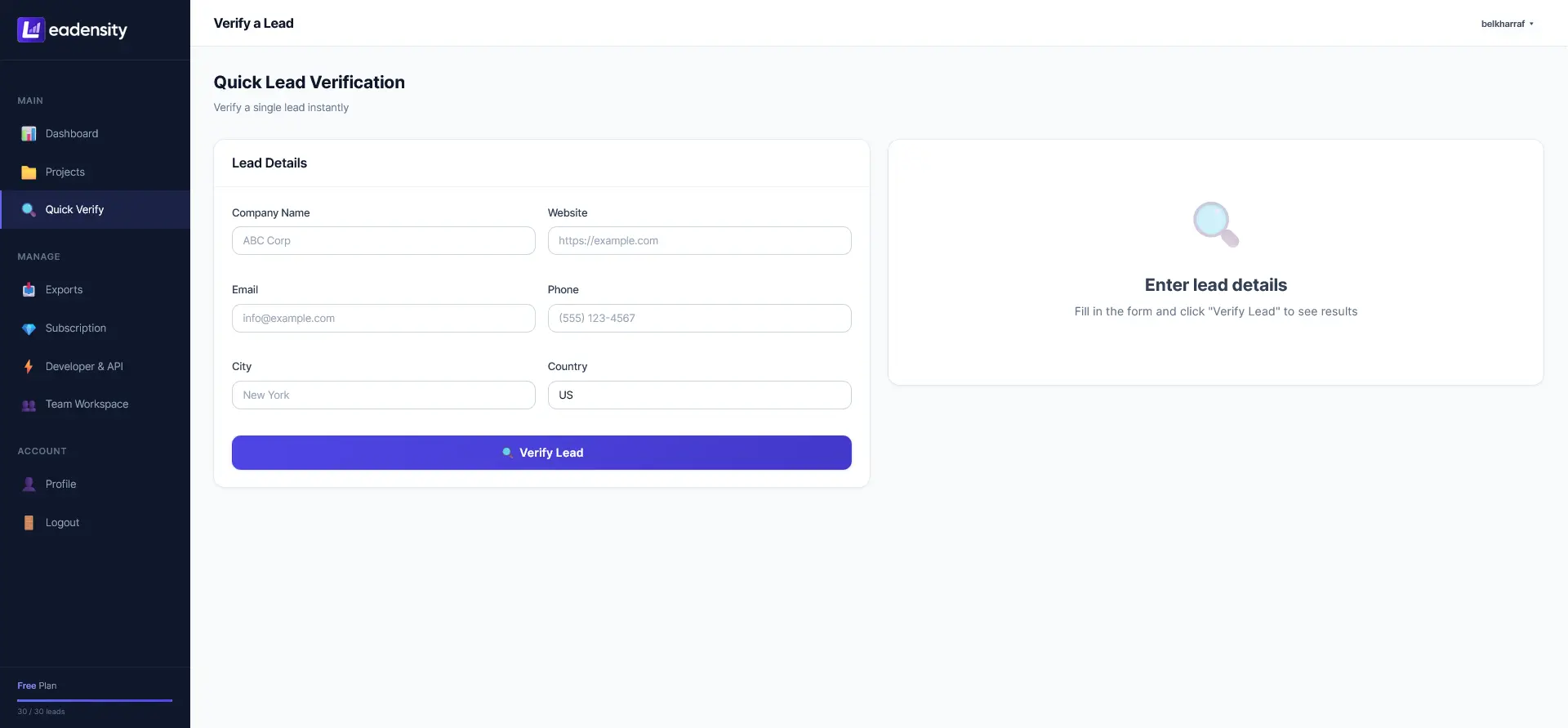
Unlike fragmented toolchains where revenue teams buy one subscription for email verification, a second tool for web scraping, and a third platform for AI copy generation, Leadensity brings the entire pipeline into a cohesive, zero-token workflow:
- Unified Data Import: Upload raw CSV files with arbitrary column headers. Leadensity intuitive column mapper pairs first names, emails, company domains, and titles automatically.
- 10-Point Technical Engine: The backend verifies DNS, MX, SMTP sockets, catch-all server logic, HTTP response codes, and SSL certificate chains.
- Local In-Browser Neural Synthesis: As verified records stream back to your browser, client-side WebGPU threads execute SmolLM2-360M-Instruct to extract corporate summaries and generate tailored conversation hooks.
- Enriched Export & Webhook Push: Filter records by quality score (e.g., Score ≥ 90) and export clean CSVs with all newly enriched columns ready for instant sequence enrollment in Smartlead, Instantly, Apollo, or HubSpot.
9. The SDR Playbook: Converting Enriched Signals into High-Reply Outbound Copy
Having enriched data is useless if sales reps continue sending generic, template-driven cold emails. Here is how modern SDRs transform Leadensity enriched data fields into high-converting outbound sequences that average 18% to 28% reply rates:
× Generic Outbound Cold Email (Unenriched):
“Hi Alex, I saw you are the VP of Engineering at Acme Cloud. We help SaaS companies optimize their cloud architecture and cut developer overhead. Do you have 15 minutes this Thursday for a quick demo?”
✓ Enriched, High-Converting Outbound Email (Powered by Leadensity Signals):
“Hi Alex — noticed your engineering team is scaling out Acme Cloud infrastructure on top of PostgreSQL and Stripe, while managing team identity through Google Workspace. Given your recent transition toward multi-region data stores, how are you currently managing automated database failover across your European clusters without impacting checkout latency? We recently helped a similar fintech team cut failover latency by 64%. Worth sharing the 2-minute blueprint?”
Because the SDR referenced verified technographic components (PostgreSQL, Stripe, Google Workspace) and an AI-synthesized pain point hook, the recipient recognizes immediately that the message was written for their specific operational reality. This level of personalization can now be generated programmatically across thousands of leads in minutes.
10. High-Volume Processing Without Server Timeouts (Browser Micro-Batching)
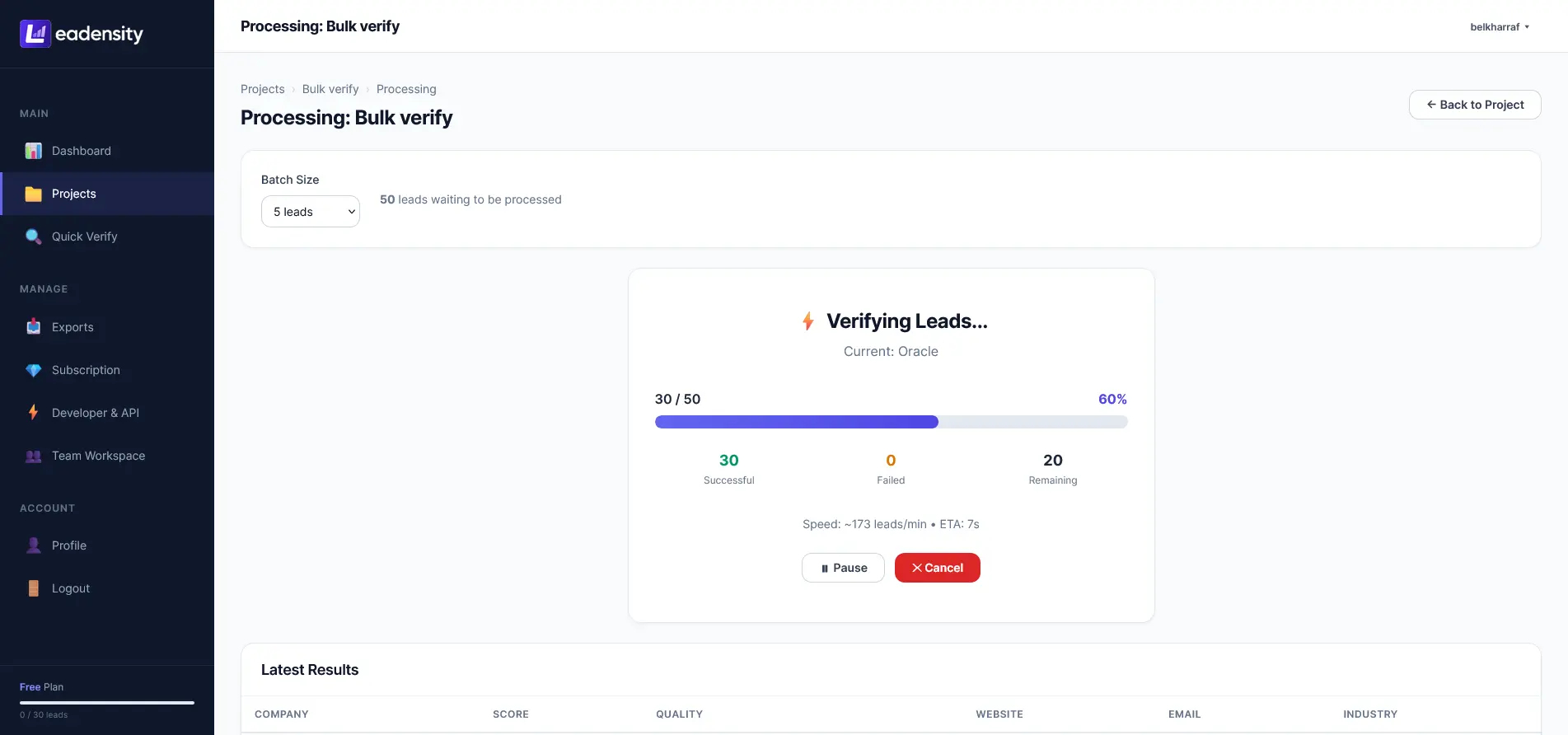
One of the most persistent frustrations with conventional lead verification and enrichment platforms is the dreaded 504 Gateway Timeout. When an application attempts to scrape 10,000 corporate websites, execute 10,000 DNS queries, and communicate with external APIs inside a single monolithic web server request, the connection inevitably collapses after 30 to 60 seconds.
Leadensity eliminates this failure point through a proprietary Client-Side Browser AJAX Micro-Batching Architecture:
- Decoupled Micro-Batches: The browser splits large CSV uploads into compact batches of 10 to 25 records.
- Asynchronous Concurrency: Each micro-batch executes through an independent asynchronous HTTP POST loop. If a single external website experiences network lag, only that individual micro-batch waits; the rest of the queue continues processing uninterrupted.
- Zero Memory Spikes: Because CSV rows are parsed as a memory stream rather than held in a monolithic server-side array, server memory consumption remains virtually flat, even when processing files containing 100,000+ leads.
- Fault-Tolerant Pause & Resume: Sales reps can pause a batch job, close their laptop, reopen it later, and resume verification from the exact record where they left off.
11. Developer Integration: REST APIs, Webhooks, and Waterfall Architecture
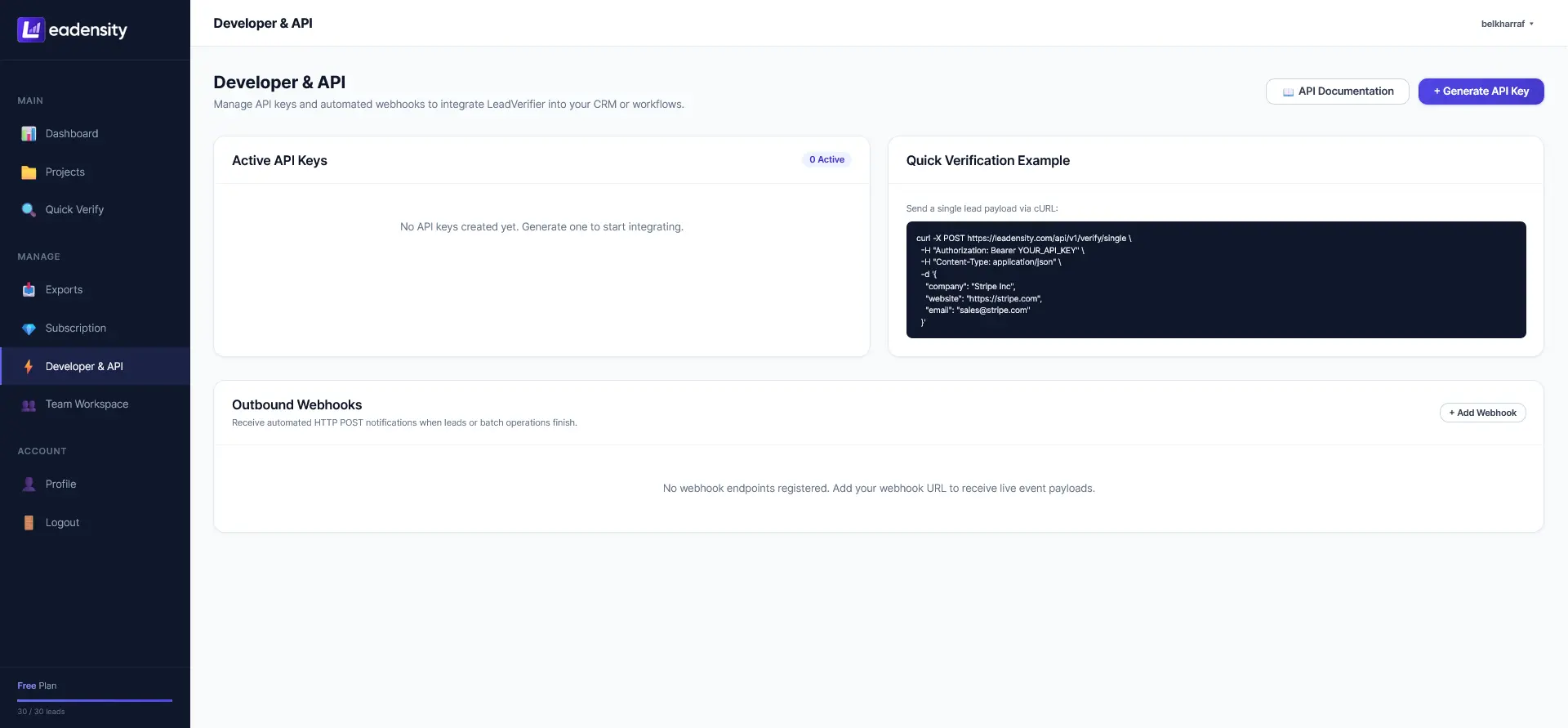
For technical founders, growth engineers, and RevOps automation specialists, lead enrichment must function programmatically within custom CRM pipelines. Leadensity provides a fully documented RESTful API and webhook subscription framework that enables instant lead qualification at the point of ingestion:
// POST https://leadensity.com/api/v1/verify
// Headers: Authorization: Bearer <LEADENSITY_API_KEY>
// Payload:
{
  "email": "elena.rostova@datadrive-bi.com",
  "domain": "datadrive-bi.com",
  "first_name": "Elena",
  "last_name": "Rostova",
  "title": "Head of Product",
  "detect_tech_stack": true,
  "enable_local_ai": true
}

// JSON Response (HTTP 200 OK):
{
  "status": "success",
  "lead_id": 84192,
  "data": {
    "deliverability": {
      "status": "valid",
      "smtp_code": 250,
      "is_catch_all": false,
      "spf_record": "v=spf1 include:_spf.google.com ~all",
      "dmarc_enforced": true
    },
    "web_health": {
      "http_code": 200,
      "ssl_valid": true,
      "domain_age_days": 890
    },
    "technographics": ["PostgreSQL", "TailwindCSS", "Segment", "Intercom", "Google Workspace"],
    "quality_score": 98,
    "quality_tier": "Tier 1 (High Priority)",
    "ai_enrichment": {
      "summary": "Enterprise cloud analytics platform optimizing SQL query performance across Snowflake and BigQuery.",
      "recommended_angle": "Focus on their recent Segment integration and high-volume event ingestion overhead."
    }
  }
}
12. Comparison Matrix: Cloud AI Scrapers vs. Legacy Tools vs. Leadensity
To visualize the operational and financial differences across B2B enrichment platforms, compare the structural capabilities below:
13. Frequently Asked Questions (FAQ)
How can an AI model run directly in the browser without an API key?
Leadensity utilizes WebGPU and WebAssembly (WASM) via Hugging Face Transformers.js v3. When you open the application, a compact, quantized neural network (SmolLM2-360M-Instruct, ~220MB) is downloaded once into your browser local storage cache. Subsequent inference operations execute directly on your device physical GPU or CPU threads, eliminating external cloud servers and recurring API token costs entirely.
Does running in-browser AI slow down my computer?
No. Leadensity executes all model inference within dedicated Web Workers operating in background threads. This architecture prevents UI stutter, maintaining a responsive 60 FPS browsing experience. Because SmolLM2 is compressed with 4-bit quantization, RAM utilization typically remains below 500MB, running smoothly even on standard modern laptops.
What technographic signals can Leadensity automatically detect?
Leadensity scans target company web servers to detect e-commerce engines (Shopify, WooCommerce, Magento), payment providers (Stripe, PayPal, Adyen), customer success widgets (Intercom, Zendesk, Drift), analytics platforms (Google Analytics 4, Segment, Mixpanel), and corporate email providers (Google Workspace, Microsoft 365, Mimecast).
Why is technical lead verification necessary before AI enrichment?
Generating brilliant AI sales hooks is completely wasted if the prospect email address bounces or hits a spam trap. Under 2026 Google and Yahoo deliverability rules, exceeding a 2% bounce rate harms your sending domain reputation. Leadensity verifies the SMTP socket, DNS health, and SSL certificate first, ensuring you only invest SDR time and outbound volume into live, reachable inboxes.
Can I integrate Leadensity enrichment into my existing CRM via API?
Yes. Leadensity provides a comprehensive REST API (POST /api/v1/verify) and real-time Webhook subscriptions. You can trigger automated verification upon form submissions, enrich incoming demo requests, and automatically push lead quality scores and tech stack data directly into HubSpot, Salesforce, or PostgreSQL.
14. Final Verdict and Strategic Implementation Roadmap
Strategic Recommendation: Shift from Cloud Tokens to Client-Side Intelligence
In 2026, relying on expensive cloud API tokens to qualify large B2B prospect lists is economically obsolete. Forward-thinking revenue teams are achieving superior unit economics and tighter data confidentiality by adopting in-browser local AI verification architectures.
By uniting 10-point technical verification, automated technographic fingerprinting, and local neural inference inside a single browser workspace, Leadensity enables growth organizations to scale outbound volume with zero token fees, zero server timeouts, and uncompromising deliverability defense.
Your 4-Step Zero-Cost Enrichment Roadmap:
- Audit Your Current AI Spend: Calculate your monthly token bills across third-party scraping and enrichment tools.
- Consolidate Deliverability & Enrichment: Stop separating verification from qualification; run both simultaneously in Leadensity.
- Filter for Tier 1 Accounts: Use Leadensity 0–100 quality scoring to route records with scores ≥90 to your top SDRs.
- Automate via Webhooks: Connect your ingestion forms to Leadensity REST API for real-time lead gating.
Supercharge Your Outbound with Zero Token Fees
Qualify, enrich, and score your prospect lists with local in-browser AI and a 10-point technical verification engine. Cut acquisition costs and defend your domain deliverability today.
Get Started with Leadensity →Instant CSV uploads. Complete WebGPU local neural execution. REST API and Webhooks included.