
B2B Lead Validation Criteria: A Quantitative Quality Scoring Framework for Marketing Directors
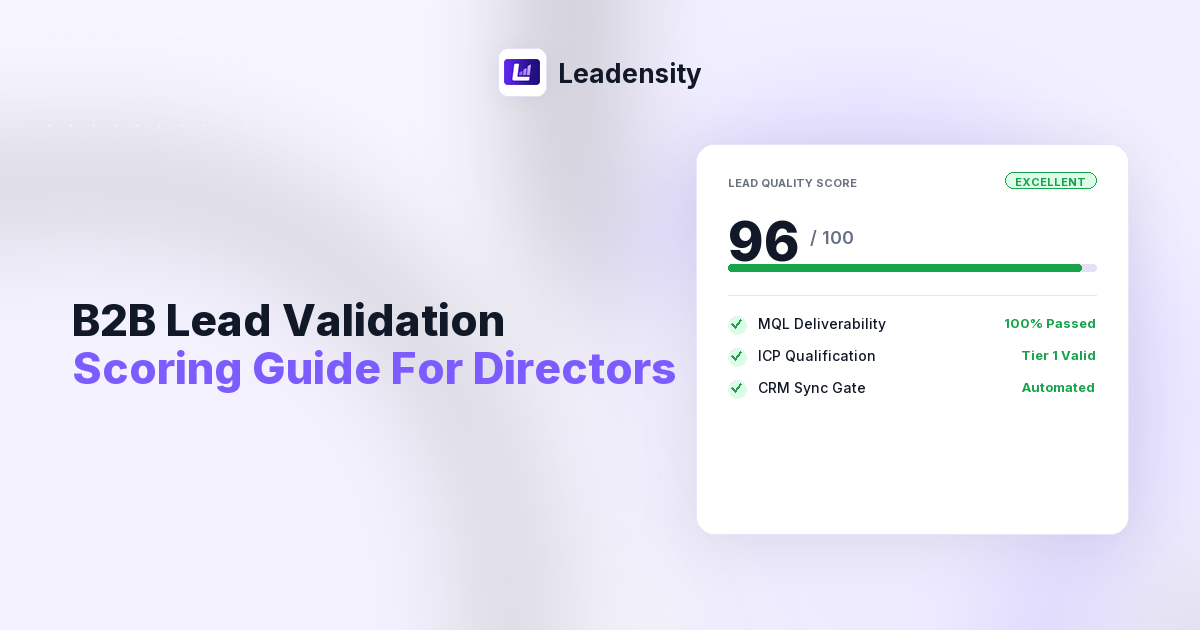
B2B lead validation criteria represent the single most contentious boundary between marketing demand generation teams and outbound sales organizations. In modern revenue operations, marketing directors are evaluated on inbound lead volume and cost per acquisition (CPA), while sales development leadership is measured on pipeline velocity, meetings booked, and closed-won revenue. This divergence frequently produces a bitter internal conflict: marketing celebrates generating 2,000 monthly marketing qualified leads (MQLs), while sales representatives complain that up to 45% of those records are undeliverable, unverified, or commercially worthless. In 2026, qualitative gut-feel qualification is obsolete. Marketing executives require a rigorous, mathematical lead validation framework that evaluates technical deliverability, corporate infrastructure health, technographic alignment, and buyer authenticity before any prospect record is synced to Salesforce or HubSpot. By establishing an automated 10-point scoring gate, revenue leaders can eliminate cross-departmental friction, protect domain reputation, and double sales development conversion efficiency.
Table of Contents
- 1. The MQL vs. SQL Crisis: Why Traditional Lead Scoring Fails
- 2. The Hidden Financial Toll of Unvalidated Leads on Sales Velocity
- 3. The 10-Point Technical Validation Scorecard
- 4. The Mathematical 0–100 Lead Quality Scoring Formula
- 5. The Marketing-Sales Service Level Agreement (SLA) Blueprint
- 6. Automated Lead Gating & Routing Tiers (Tier 1 vs. Tier 2 vs. Quarantine)
- 7. In-Browser Local AI as an Objective ICP Gatekeeper
- 8. Step-by-Step SOP for Marketing Operations and RevOps
- 9. Eliminating Timeouts During Mass List Cleansing (Browser Micro-Batching)
- 10. Real-Time API Form Gating and CRM Webhook Synchronization
- 11. Qualitative vs. Quantitative Validation Models Compared
- 12. Frequently Asked Questions (FAQ)
- 13. Final Verdict and Marketing Director Execution Checklist
1. The MQL vs. SQL Crisis: Why Traditional Lead Scoring Fails
For over a decade, marketing operations teams relied on behavioral activity scoring built into legacy marketing automation platforms like Marketo, Pardot, and HubSpot. In this legacy paradigm, a prospect was awarded +5 points for opening an email, +10 points for visiting a pricing page, and +20 points for downloading an ungated whitepaper. Once an arbitrary threshold of 50 or 75 points was reached, the system labeled the contact a “Marketing Qualified Lead” and immediately assigned it to a sales development representative.
In 2026, this model has completely broken down due to three fundamental flaws:
- The Bot Activity Distortion: Modern corporate email security gateways (Proofpoint, Mimecast, Barracuda, Microsoft Defender) automatically open every inbound link and trigger email tracking pixels in a sandbox to inspect for malware. This automated security scanning inflates behavioral scores, causing dead leads to appear highly engaged.
- Zero Deliverability Accountability: Traditional behavioral scoring systems do not verify whether the email address is technically deliverable, whether the domain MX records are active, or whether the mailbox is a toxic spam trap. An individual can fill out a form with
asdf@fakecompany.com, download an asset, and trigger an automated task for an SDR. - Unverified Buying Authority: Downloading a PDF does not indicate purchasing authority or technical fit. Sales reps waste precious working hours chasing students, consultants, or junior employees who lack the budget or administrative mandate to purchase enterprise software.
When sales teams spend 30% of their workday contacting fake addresses or unverified accounts, trust in marketing collapses. Sales representatives begin ignoring incoming MQL notifications, resorting to their own ad-hoc prospecting, which drives up customer acquisition costs and fragments pipeline reporting.
2. The Hidden Financial Toll of Unvalidated Leads on Sales Velocity
The impact of unvalidated lead data extends far beyond interpersonal friction between marketing and sales leaders; it inflicts measurable, severe damage on company financial performance:
Financial Impact Model: A 10-Rep Sales Team Handling 2,000 Unvalidated Leads/Mo
- Wasted SDR Labor Hours: At an industry average of 18 minutes spent researching, personalizing, and attempting outreach on an unverified lead that bounces or turns out to be invalid, 600 bad leads consume 180 hours of representative labor every month (equivalent to one full-time SDR salary completely burned).
- Sender Reputation Damage: Incurring a hard bounce rate over 2.5% triggers automatic throttling from Google Workspace and Microsoft 365, dropping cold outbound inbox placement by up to 40% across all company reps.
- CRM Database Bloat: Storing tens of thousands of dormant, unverified contacts in enterprise CRMs pushes organizations into higher software billing tiers ($10,000+ annually) while degrading marketing automation reporting accuracy.
Rigorous lead validation is not an administrative burden; it is an executive-level revenue protection strategy that directly increases sales capacity and accelerates deal velocity.
3. The 10-Point Technical Validation Scorecard
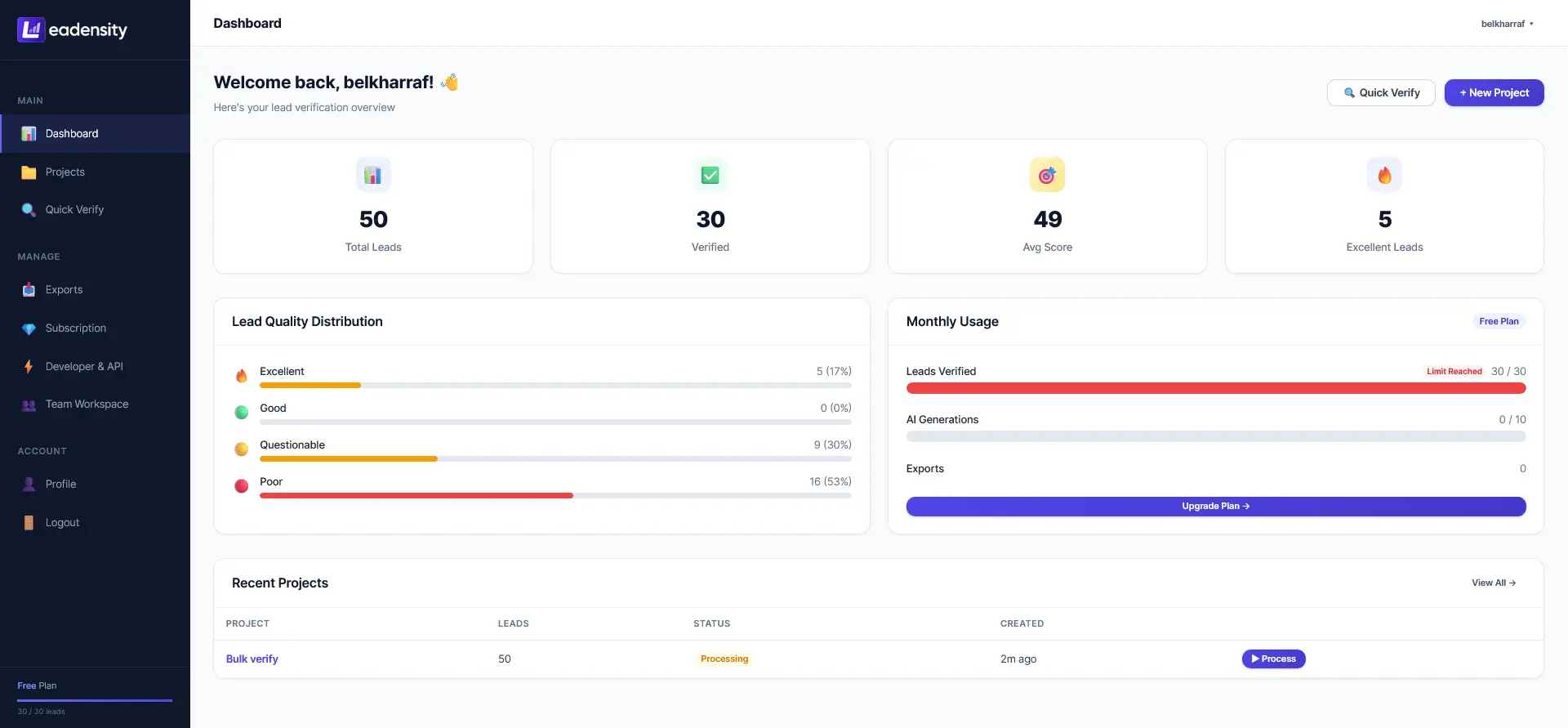
To eliminate ambiguity, marketing directors must deploy an objective, non-negotiable 10-point technical validation scorecard. In the Leadensity engine, every inbound or outbound record is audited across these ten sequential vectors before it is deemed sales-ready:
1. RFC Syntax & Format Compliance
Verifies compliant mailbox formatting, valid character sequences, and correct top-level domain (TLD) structure under RFC 5322.
2. DNS Mail Exchange (MX) Resolution
Queries global DNS root zones to confirm the target corporate domain maintains active, resolving MX host records.
3. Live SMTP Socket Handshake
Connects directly to the receiving mail server on port 25 to verify recipient existence (250 OK) without delivering an actual message.
4. Catch-All (Accept-All) Multi-Probe Detection
Sends high-entropy decoy probes to detect whether the server accepts all incoming addresses, applying specialized risk tiering.
5. Disposable & Temporary Email Identification
Cross-references domains against a real-time database of over 85,000 throwaway email services (Mailinator, TempMail, GuerrillaMail).
6. Role-Based Account Filtering
Identifies generic corporate distribution aliases (sales@, info@, support@, billing@) that yield low sales conversion.
7. Corporate Website HTTP/HTTPS Health
Verifies the company root website returns a clean HTTP 200 OK status and is not pointing to an inactive domain parking registrar.
8. SSL/TLS Certificate Chain Validation
Validates that the target domain holds a current, cryptographically valid SSL certificate issued by a recognized root authority.
9. Technographic Stack Fingerprinting
Detects installed software ecosystems (CRM, payments, e-commerce, cloud hosting) to confirm company operational maturity.
10. In-Browser Local AI ICP Qualification
Executes local neural inference (`SmolLM2-360M-Instruct`) to match job title, company positioning, and industry fit against your ideal buyer persona.
4. The Mathematical 0–100 Lead Quality Scoring Formula
To eliminate subjective debates between teams, Leadensity processes the 10 verification signals through a deterministic mathematical scoring formula. The total score (S) is calculated out of 100 maximum points:
Where:
• Deliverability (40 pts): Syntax (+5), MX Record (+10), SMTP Handshake (+20), Non-Disposable (+5)
• Domain Health (25 pts): HTTP 200 Live (+10), Valid SSL (+5), Mature Domain Age (+5), Non-Parked (+5)
• Technographic Fit (20 pts): Complementary CRM/Stack Detected (+10), Enterprise ESP (+10)
• AI ICP Alignment (15 pts): Title Match (+5), Company Relevance (+10)
Deductions:
• Toxic Catch-All / Jitter Anomaly: -25 pts
• Generic Role-Based Alias: -15 pts
Every lead processed through this algorithm emerges with a transparent numeric score that removes all guesswork from the qualification process.
5. The Marketing-Sales Service Level Agreement (SLA) Blueprint
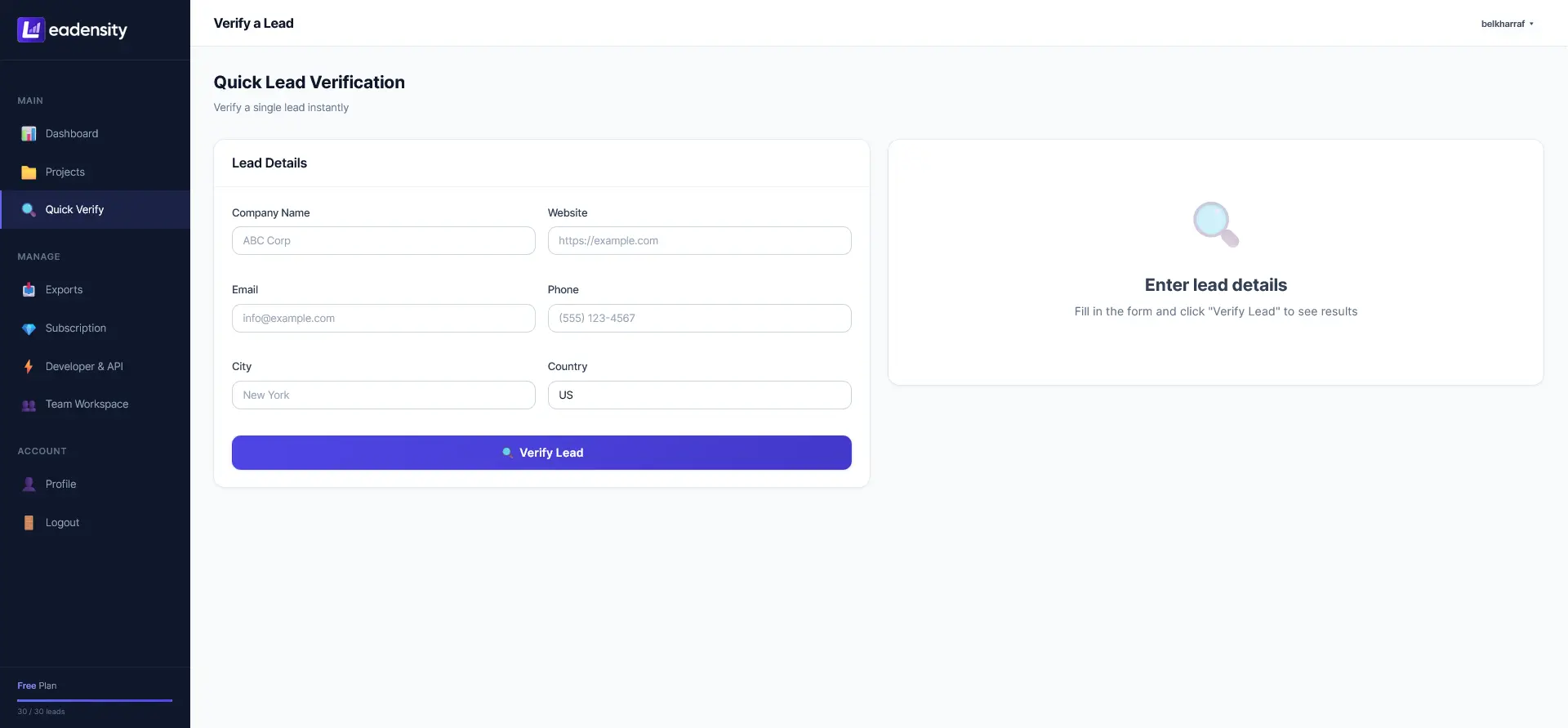
With an objective mathematical scoring formula in place, marketing directors can establish a formal Service Level Agreement (SLA) with sales leadership. Below is the contractual SLA template adopted by leading B2B SaaS revenue teams:
6. Automated Lead Gating & Routing Tiers (Tier 1 vs. Tier 2 vs. Quarantine)
Deploying objective validation criteria allows revenue operations to automate lead routing with surgical precision:
7. In-Browser Local AI as an Objective ICP Gatekeeper
Technical checks confirm whether a lead *can* be reached, but only artificial intelligence can evaluate whether the lead *should* be reached. In traditional workflows, adding AI qualification required expensive API keys and recurring per-token fees. Leadensity integrates SmolLM2-360M-Instruct directly into the client web browser via WebGPU and WebAssembly (WASM).
Operating completely in-browser with zero external API fees, the local model reads the prospect title, company description, detected tech stack, and corporate website text to compute an objective ICP score. It flags anomalies like consumer domains, mismatched seniority titles (e.g., interns attempting to download enterprise software), or non-commercial entities, ensuring that only genuine corporate decision-makers are escalated to sales teams.
8. Step-by-Step SOP for Marketing Operations and RevOps
To implement this framework across your organization, execute the following 4-step standard operating procedure:
- Audit Inbound Form Capture Fields: Ensure web forms collect company website domain alongside business email. Remove excessive friction fields (phone, postal address) and rely on Leadensity automated enrichment to backfill missing parameters.
- Configure Leadensity Pre-CRM Webhook: Point inbound lead webhooks to Leadensity
/api/v1/verifyendpoint before passing data to HubSpot or Salesforce. - Establish Hard Quality Filters: In your CRM integration settings, set an automated routing rule: if
lead_score < 85, tag lead asStatus: Marketing Nurtureand suppress SDR notification. - Weekly Validation Review: Review the Leadensity Analytics Dashboard every Monday morning with sales leadership to inspect bounce rates, catch-all distribution, and disqualification metrics.
9. Eliminating Timeouts During Mass List Cleansing (Browser Micro-Batching)
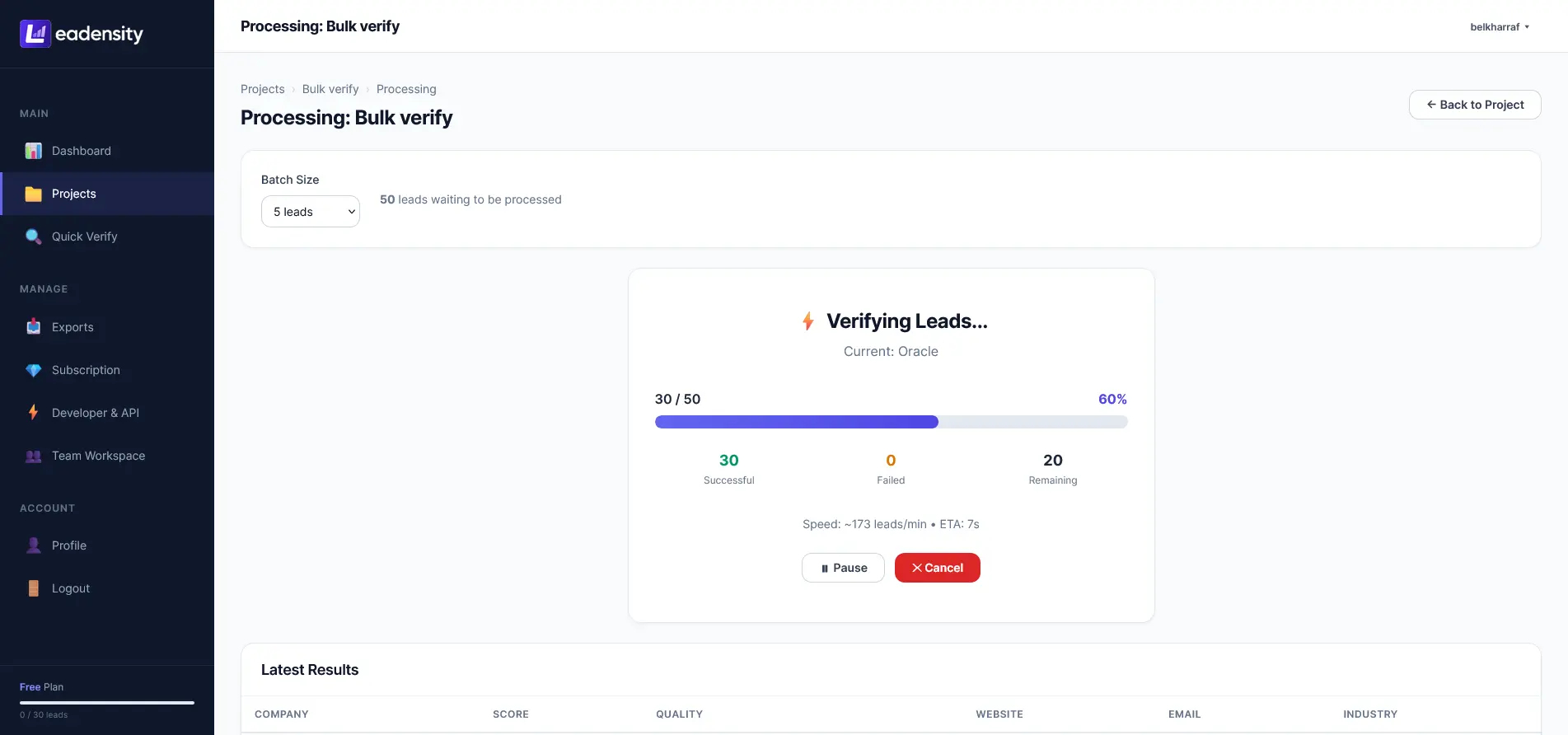
When marketing teams acquire external event attendee lists or partner databases containing 20,000+ contacts, verifying those lists through legacy platforms frequently leads to 504 Gateway Timeout errors. Because server-side scripts must wait for external DNS queries and TCP socket responses, long batches crash web servers.
Leadensity solves this through Client-Side Browser AJAX Micro-Batching. By breaking large CSV files into streams of 10 to 25 records dispatched asynchronously from your browser, verification jobs execute continuously without consuming server worker threads or hitting gateway time limits. Marketing teams can cleanse 50,000-lead lists smoothly in a single browser tab.
10. Real-Time API Form Gating and CRM Webhook Synchronization
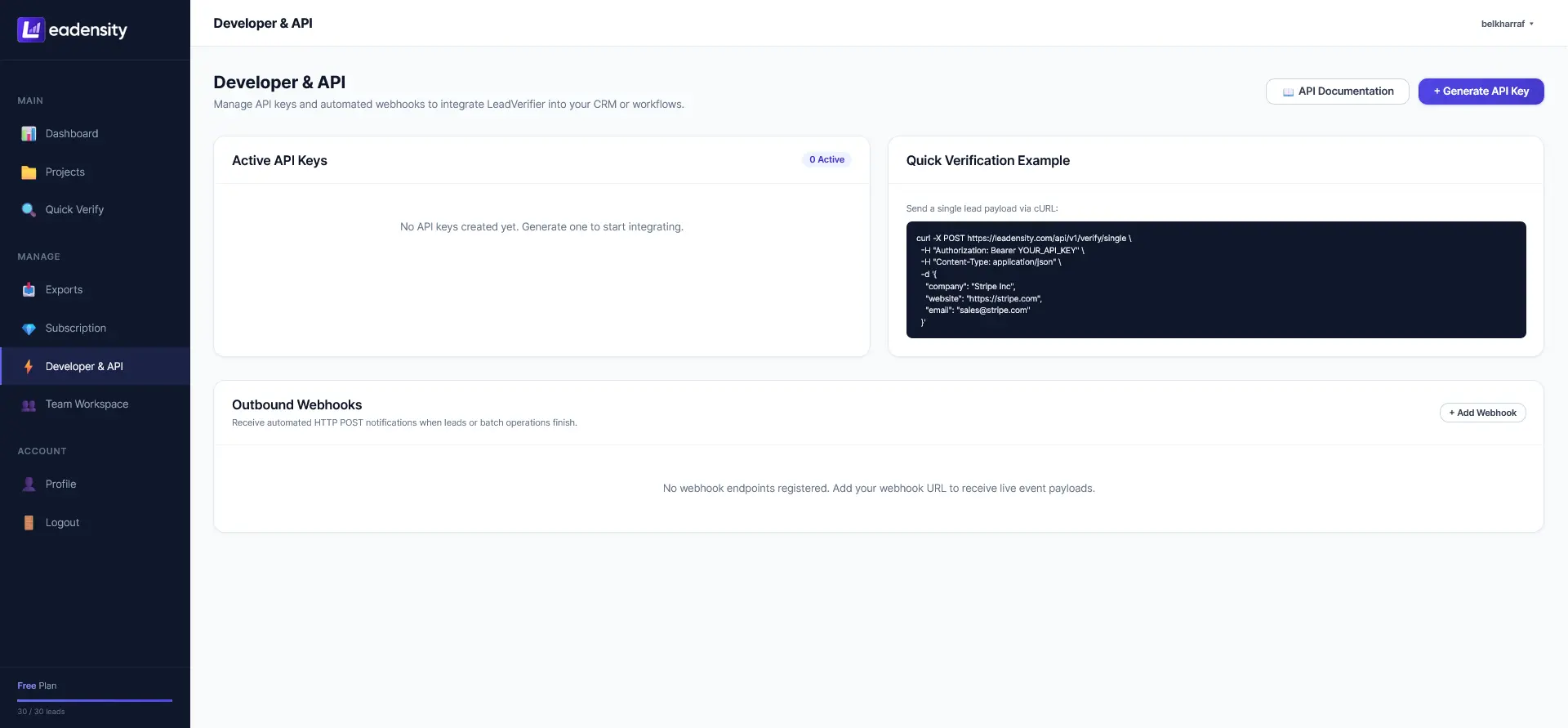
For high-velocity marketing pipelines, lead validation must operate in real time at the point of capture. Leadensity exposes a high-throughput REST API that allows marketing operations engineers to gate form submissions instantly:
// Real-Time Form Submission Gating via Leadensity REST API
// POST https://leadensity.com/api/v1/verify
// Headers: Authorization: Bearer <LEADENSITY_API_KEY>
{
  "email": "danielle.ross@enterprise-saas.com",
  "domain": "enterprise-saas.com",
  "first_name": "Danielle",
  "last_name": "Ross",
  "title": "Director of Demand Generation",
  "auto_score": true
}

// JSON Response (HTTP 200 OK):
{
  "status": "success",
  "validation": {
    "deliverable": true,
    "smtp_response": "250 OK",
    "is_catch_all": false,
    "web_status": 200,
    "ssl_valid": true,
    "lead_score": 96,
    "tier": "Tier 1",
    "crm_routing": "direct_to_sdr"
  }
}
11. Qualitative vs. Quantitative Validation Models Compared
To understand the operational leap between traditional manual qualification and Leadensity automated quantitative framework, review the comparison matrix below:
12. Frequently Asked Questions (FAQ)
What is the primary difference between lead validation and lead qualification?
Lead validation is the technical and operational verification that a prospect record represents a real, reachable, and authenticated business contact (valid SMTP, live web server, authentic domain). Lead qualification evaluates commercial readiness and budget alignment. Without automated technical validation, sales teams waste valuable qualification time on dead accounts and fake contact details.
Why should marketing teams care about email deliverability scores?
Under modern deliverability standards enforced by Google and Microsoft in 2026, sending emails to lists with bounce rates above 2% degrades your domain reputation algorithmically. When marketing teams feed unverified lists into outbound sales sequences, secondary sending domains burn quickly, causing outbound pipeline to drop to near zero.
How does technographic detection improve sales development conversion?
Technographic signals reveal the prospect active software environment (e.g., whether they use Stripe, HubSpot, Shopify, or Google Workspace). This allows SDRs to open conversations with relevant integration points and competitive displacement hooks, increasing meeting booking rates by over 40% compared to generic cold messaging.
Can this framework be automated inside HubSpot or Salesforce?
Yes. Leadensity provides high-performance REST API endpoints and outgoing webhooks. Incoming leads can be routed to Leadensity for instant 10-point scoring, and the resulting quality score (0–100) and technographic metadata are automatically appended to the CRM contact record before SDR notification.
How does Leadensity ensure zero token fees for AI qualification?
Unlike platforms that route prospect data to external third-party model APIs, Leadensity executes local neural inference directly in your browser using SmolLM2-360M-Instruct via WebGPU and WebAssembly (WASM). This provides instantaneous qualification summaries with zero external token costs and total data privacy.
13. Final Verdict and Marketing Director Execution Checklist

Strategic Recommendation: Gate Your Pipeline Before CRM Sync
The era of passing unverified contact lists to sales teams is over. By establishing quantitative, automated lead validation criteria, marketing directors protect sender reputation, restore sales trust, and ensure SDRs invest their time exclusively into high-converting accounts.
Leadensity combines a 10-point technical validation engine with technographic detection and in-browser local AI, giving revenue teams the unified infrastructure needed to scale outbound pipeline with total confidence.
Your 5-Point Marketing Director Implementation Checklist:
- Deploy Technical Validation: Never push an unscrubbed list into CRM sequences.
- Sign the SLA: Establish a contractual 85+ score threshold for sales handoffs.
- Enforce Catch-All Rules: Never send more than 15% catch-all leads in a single batch.
- Leverage Tech Signals: Equip SDRs with verified technographic data for personalized outreach.
- Automate Real-Time Gating: Connect lead capture forms to Leadensity REST API.
Establish Quantitative Lead Quality Standards Today
Bridge the gap between marketing demand generation and outbound sales. Validate deliverability, uncover tech stacks, and score leads with Leadensity 10-point engine.
Start Validating Leads with Leadensity →Instant CSV list uploads. Zero server timeouts. High-performance REST API and webhooks included.