
B2B Lead Verification Best Practices: How to Validate, Clean, and Score Prospect Lists in 2026

B2B lead verification is the multi-layered process of validating the technical deliverability, domain infrastructure, corporate authenticity, and commercial viability of a sales prospect before initiating outbound contact. In 2026, where Google and Yahoo enforce strict spam thresholds under 0.3% and corporate privacy firewalls routinely discard unverified cold emails, standard regex syntax checking is no longer enough. Clean pipelines require a comprehensive 10-point verification engine that inspects DNS infrastructure, MX routing, mail server response codes, SSL certificates, website health, tech stack signatures, and weighted lead quality scoring. By verifying your prospect records in bulk before launching campaigns, your team prevents mailbox blacklisting, cuts customer acquisition costs by up to 42%, and ensures sales development reps invest time exclusively into genuine, reachable decision-makers.
Table of Contents
- 1. The 2026 B2B Lead Decay Crisis and Deliverability Landscape
- 2. Anatomy of Spam Traps: Pristine vs. Recycled Honeypots
- 3. Email Scraping vs. Verification vs. Sales Intelligence
- 4. The 10-Point Technical Lead Verification Blueprint
- 5. Deep Dive: SMTP Handshakes, Catch-All Mailboxes, and Graylisting
- 6. Dynamic Lead Scoring (0-100) and Quality Tiering
- 7. In-Browser AI Qualification and Sales Opportunity Detection
- 8. Bulk Verification Workflows: Processing 50,000+ Leads Without Timeouts
- 9. Five Costly Lead Verification Mistakes Outbound Teams Make in 2026
- 10. Real-Time API Gating and Webhook CRM Synchronization
- 11. Verification Approaches Compared: Syntax vs. Scrapers vs. Leadensity
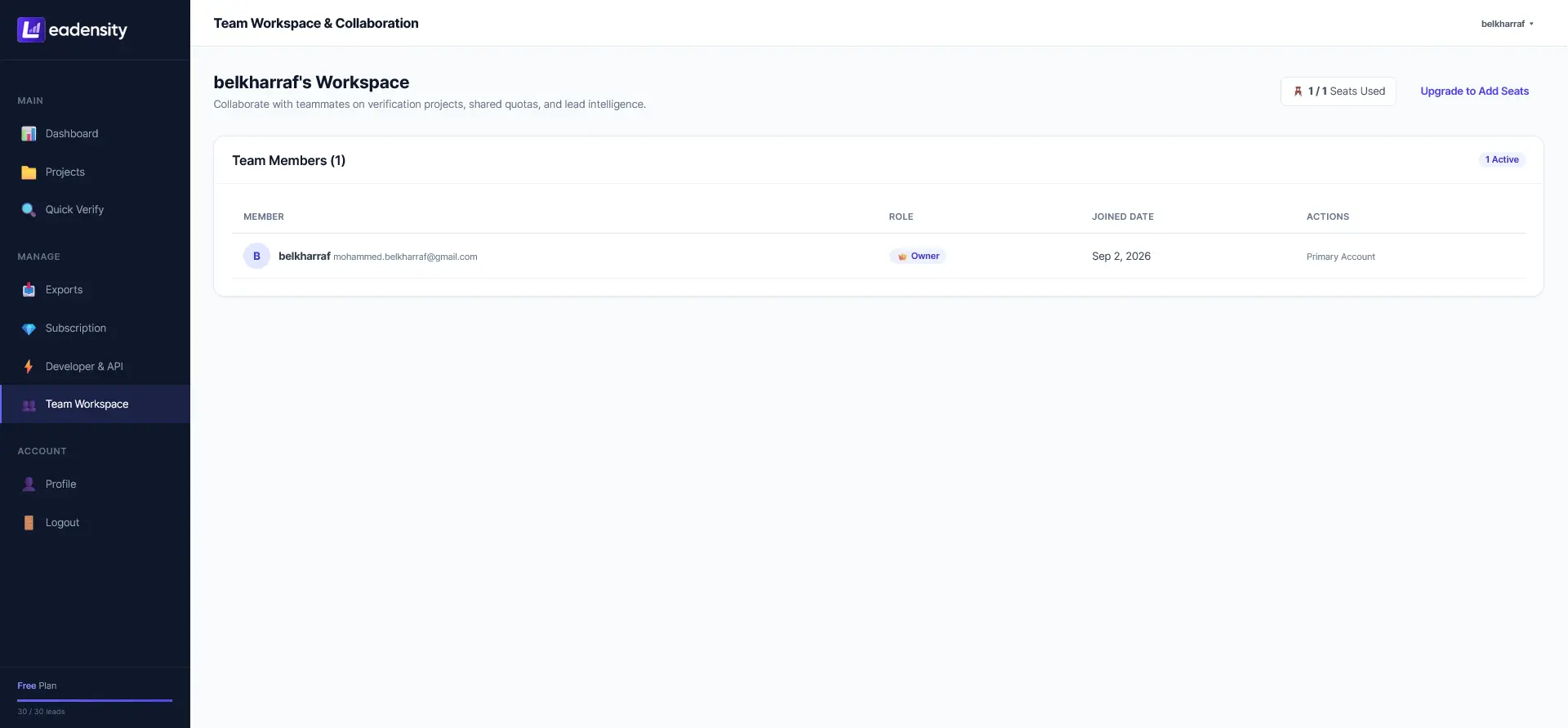
- 12. Step-by-Step SOP for SDRs, Growth Teams, and Agencies
- 13. Frequently Asked Questions
- 14. Final Verdict and Strategic Recommendation
1. The 2026 B2B Lead Decay Crisis and Deliverability Landscape
B2B contact data deteriorates at a measured rate of 2.5% to 3% each month. Over an annual sales cycle, more than 30% of any unmaintained prospect database becomes completely invalid due to executive turnover, company acquisitions, domain expirations, corporate restructuring, and email address retirements. Feeding unvalidated data into cold email sequences or automated dialers creates catastrophic downstream consequences.
In 2026, the penalties for poor list hygiene are severe. Major internet service providers and email gatekeepers (including Google Workspace, Microsoft 365, and corporate security filters such as Proofpoint, Mimecast, and Barracuda) enforce rigid spam thresholds. Senders exceeding a bounce rate of just 2% or generating spam complaint ratios above 0.1% suffer immediate algorithmic throttling. Once a secondary domain or corporate sending IP is flagged, your deliverability across every outreach campaign plummets, causing mission-critical business communications to land in spam folders.
Beyond domain reputation damage, dirty data wastes costly SDR labor. Research across high-growth sales teams demonstrates that outbound representatives spend between 21% and 27% of their working hours researching dead accounts, chasing outdated contact emails, or troubleshooting disconnected corporate telephone numbers. Rigorous lead validation is no longer an optional administrative hygiene task; it is the fundamental infrastructure upon which predictable outbound pipeline generation depends.
2. Anatomy of Spam Traps: Pristine vs. Recycled Honeypots
One of the most perilous hazards lurking within unverified B2B lead databases is the spam trap. Security providers, blocklist operators (such as Spamhaus and Barracuda), and mailbox providers design spam traps specifically to catch automated scrapers, cold outreach spammers, and organizations purchasing questionable contact lists. Understanding the two primary categories of traps illustrates why surface-level syntax scrubbers fail to protect sending domains:
Pristine Spam Traps
Pristine traps are email addresses and domain names created exclusively by anti-spam organizations that have never been owned or registered by a genuine human being. These addresses are deliberately embedded as hidden links or plaintext strings inside raw web source code, directory footers, and obscure discussion forums where only automated harvesting bots and scrapers will find them. Because a pristine trap has never opted into any marketing communication, sending even a single email to one of these addresses provides conclusive proof to blocklist maintainers that your organization uses non-permissioned scraping methods. Hitting a pristine trap can trigger immediate, network-wide domain blacklisting within hours.
Recycled Spam Traps
Recycled traps are legacy corporate email addresses that were once valid human mailboxes but were subsequently abandoned following employee departures or corporate dissolution. After a designated period of dormancy (typically 12 to 18 months) during which incoming messages return hard bounce status codes (550 User Unknown), the mailbox provider reactivates the address as a silent honeypot. Senders who continue delivering campaigns to these deactivated inboxes without updating their CRM hygiene are penalized for poor data practices. A comprehensive verification platform flags long-abandoned and high-risk domains before your sending mailboxes ever transmit a message.
3. Email Scraping vs. Verification vs. Sales Intelligence
A frequent error among outbound growth leaders is assuming that buying a list from a B2B contact database or scraping profiles off social networks equates to possessing verified leads. In reality, data providers, email scrapers, and verification engines perform entirely distinct functions across the outbound tech stack.
Email Scraping and Contact Extraction
Scraping tools crawl social networks, company registries, and public directories to extract raw data strings matching common naming conventions (such as first.last@company.com). These platforms optimize for database breadth rather than operational validity. As a result, scraped lists regularly include inactive addresses, role accounts (such as info@, support@, or sales@), catch-all mailboxes that absorb messages without active recipients, and toxic spam traps deliberately placed by security vendors to capture automated harvesters.
Basic Email Verification
Standard email scrubbers verify whether an email string adheres to RFC 5322 formatting standards and performs a basic DNS MX record lookup. While necessary, this surface-level check overlooks critical operational parameters. A domain might maintain a valid MX record while the underlying corporate website is offline, the company has ceased operations, the mailbox is catch-all, or the domain lacks vital SPF, DKIM, and DMARC authentication.
Comprehensive Sales Intelligence and Multi-Point Verification
Full-stack verification platforms like Leadensity bridge the gap between technical deliverability and commercial relevance. Rather than checking email strings in isolation, Leadensity evaluates the target business holistically. It verifies domain connectivity, inspects SSL security certificates, follows redirect chains, analyzes DNS infrastructure, extracts structured corporate schemas, fingerprints the underlying technology stack, categorizes the business into one of 27 industry verticals, and computes actionable sales pitch opportunities. This comprehensive profile equips sales teams to reach decision-makers with tailored, context-aware messaging.

Automate your list qualification using real-time DNS queries, MX verification, tech detection, and algorithmic lead quality grading before importing to your CRM.
4. The 10-Point Technical Lead Verification Blueprint
To insulate your domain reputation from deliverability shocks and guarantee top-tier conversion rates, prospect records must undergo systematic technical inspection. Leadensity employs a 10-point verification engine that processes every contact across multiple infrastructural layers.
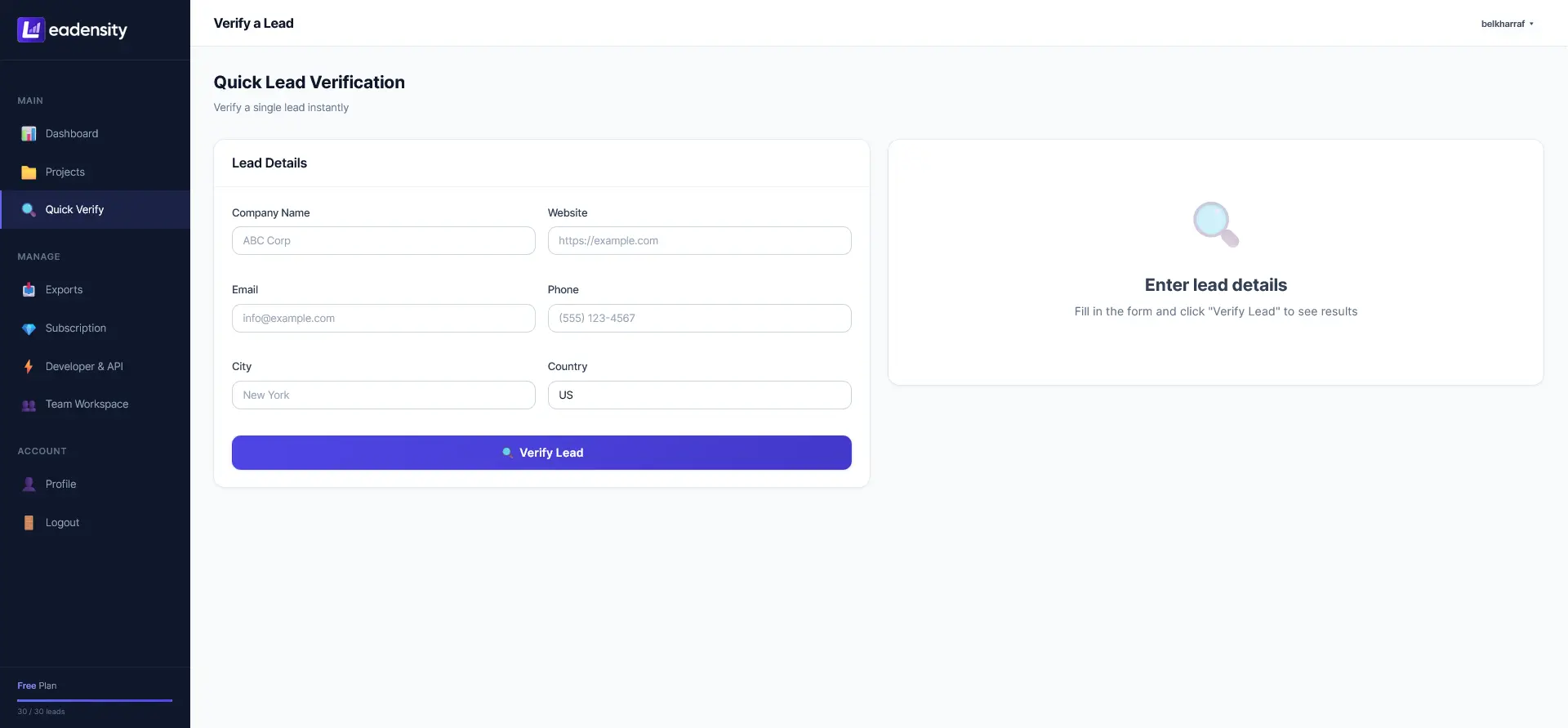
1. HTTP and HTTPS Availability Validation
The engine initiates low-latency HTTP and HTTPS handshake requests to verify whether the prospect company maintains an active, responsive web presence. Domains returning connection timeouts, 404 Not Found, 500 Internal Server Errors, or DNS resolution failures are immediately flagged as inactive or distressed accounts.
2. SSL Certificate Status and Expiration Tracking
Modern B2B transactions require secure communication channels. Inspecting the SSL/TLS certificate confirms that the company maintains modern web standards, encrypts data transmission, and is actively managed by a dedicated technical administrator. Expired or self-signed certificates highlight immediate sales opportunities for security, managed IT, and web development vendors.
3. HTTP Redirect Chain Tracing
Prospect domains frequently undergo rebranding, mergers, or corporate restructuring. Following HTTP 301 and 302 redirect paths uncovers the true canonical destination domain. This ensures that outbound communications reference current brand identities rather than obsolete corporate monikers.
4. DNS Infrastructure and Authoritative Record Lookups
The verification pipeline queries authoritative name servers for A, AAAA, MX, and TXT records. Confirming the presence of active A records verifies valid server hosting, while querying MX records confirms that the domain is configured to receive inbound electronic mail.
5. RFC Syntax and Format Conformance
Every email string is parsed against standard RFC 5322 and RFC 822 syntax rules. This catches fatal formatting bugs such as missing @ symbols, illegal special characters, spaces, misplaced trailing dots, and invalid top-level domain extensions prior to dispatch.
6. Disposable and Temporary Mailbox Filtering
Inbound lead forms are regularly poisoned by ephemeral email services (such as Mailinator, 10MinuteMail, and Guerrilla Mail) generated by casual browsers seeking whitepapers. Leadensity matches addresses against an actively updated database of thousands of disposable domains, eliminating zero-value contacts before they enter your CRM.
7. Consumer Webmail Domain Detection
In high-value B2B enterprise sales, targeting generic consumer webmail addresses (such as Gmail, Yahoo, Hotmail, or Outlook.com) undermines personalization and lowers deal velocity. The verification engine distinguishes enterprise domains from personal consumer inboxes, enabling teams to enforce strict corporate email requirements on inbound forms and outbound filters.
8. Structured Business Schema and Contact Parsing
The engine scrapes Schema.org structured metadata (JSON-LD, Microdata) from the prospect website to verify official corporate registration data, physical street addresses, primary telephone numbers, executive leadership, and social profile links across LinkedIn, X, Facebook, and YouTube.
9. Technology Fingerprinting Across 20+ Platforms
Inspecting HTTP response headers, meta generators, script tags, and DOM signatures enables Leadensity to fingerprint the target company technical architecture. The system identifies CMS platforms (WordPress, Shopify, Webflow, Squarespace, Magento, Drupal), frontend frameworks (React, Vue, Next.js), analytics trackers (Google Analytics 4, Segment, Mixpanel, Hotjar), and advertising pixels (Meta Pixel, LinkedIn Insight Tag, Google Ads).
10. Industry Classification Across 27 B2B Verticals
Using a weighted contextual keyword classification model, Leadensity analyzes on-page copy, metadata, and structural headers to assign the prospect into one of 27 distinct B2B/B2C industry verticals (including SaaS, Healthcare, Real Estate, E-Commerce, Legal, Finance, Construction, and Logistics). This powers precise campaign segmentation and contextual outbound messaging.
5. Deep Dive: SMTP Handshakes, Catch-All Mailboxes, and Graylisting
A sophisticated verification protocol involves understanding how mail transfer agents (MTAs) interact over SMTP port 25. While standard verifiers terminate inspection after an MX record lookup, enterprise validation requires simulating an actual delivery transaction without sending an email message:
The SMTP Dialogue Protocol
The verification client initiates a connection to the primary destination mail server uncovered in the DNS MX lookup. It issues an EHLO/HELO handshake command identifying a valid sending hostname, followed by a MAIL FROM:<probe@verified-domain.com> declaration. Next, it issues RCPT TO:<prospect@company.com>. At this stage, the destination server responds with an SMTP status code:
- 250 OK: The mailbox exists, is active, and is prepared to receive messages. The client immediately sends
RSETandQUITcommands, cleanly closing the socket without depositing an email into the user inbox. - 550 / 551 / 553 User Unknown: The mailbox does not exist on the target server. This confirms a hard bounce condition.
- 450 / 451 / 452 Temporary Failure: The mailbox is temporarily unavailable, over quota, or enforcing rate limits.
Handling Catch-All (Accept-All) Servers
Approximately 35% of B2B corporate domains configure their mail servers (particularly Microsoft 365 and Google Workspace instances) in catch-all mode. On a catch-all server, any recipient query, even a completely fabricated random string such as random_xyz_98765@company.com, will return code 250 OK. If an outreach team relies on naive SMTP checks, catch-all addresses appear 100% valid, only to bounce silently days later when internal routing rules reject the unknown username.
Leadensity detects catch-all behavior by performing baseline differential testing: querying an intentionally randomized non-existent address alongside the prospect address. If both return 250 OK, the domain is flagged as catch-all. The platform then pairs domain reputation scores, employee tenure signals, and secondary enrichment markers to assign a calibrated confidence index, preventing unexpected campaign bounces.
Navigating Graylisting Delays
Many enterprise mail gateways employ graylisting as an anti-spam tactic. When a new verification IP connects for the first time, the destination server temporarily rejects the connection with a 451 Try Again Later code, expecting legitimate mail servers to retry after a short interval while automated spam scripts drop the connection. Robust verification engines track graylisting headers and manage retry queues so authentic prospect mailboxes are not falsely marked as invalid.
6. Dynamic Lead Scoring (0-100) and Quality Tiering
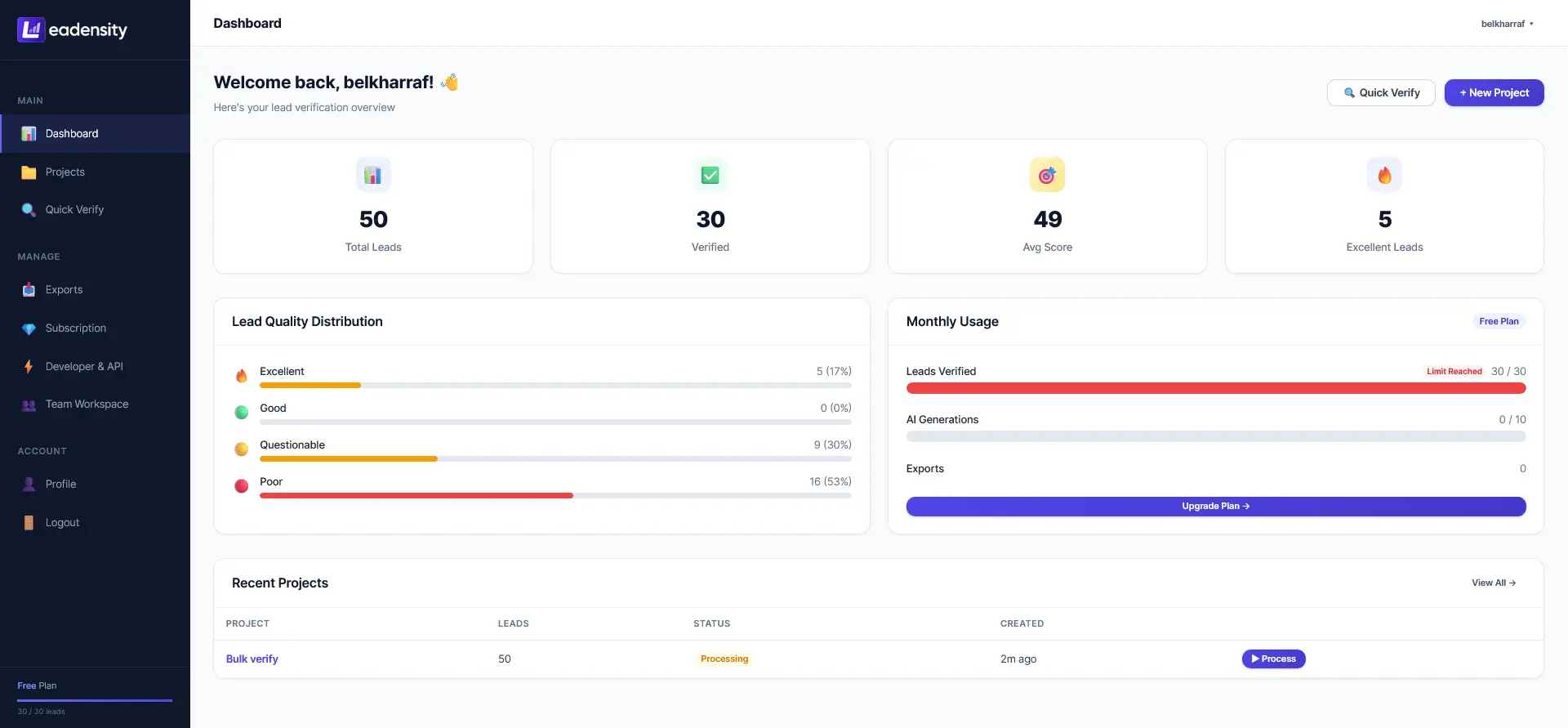
Raw technical data points are only valuable when synthesized into clear operational metrics that sales representatives can act upon instantly. Leadensity calculates a transparent, weighted lead quality score between 0 and 100 for every prospect, automatically sorting records into four actionable quality tiers.
Verified corporate domain, healthy HTTPS/SSL, dedicated MX infrastructure, business phone, complete social profiles, and confirmed active website. Immediate priority for SDR outbound sequences.
Valid email deliverability and active website, but lacking minor enrichment parameters such as direct phone numbers or complete schema data. Qualified for standard automated outreach.
Leads utilizing consumer webmail domains, exhibiting multiple redirects, missing SSL certificates, or hosting minimal content. Requires manual research before dispatching cold email.
Dead websites, missing MX records, syntax errors, or confirmed disposable inboxes. Must be automatically purged from outbound systems to prevent domain blacklisting.
7. In-Browser AI Qualification and Sales Opportunity Detection
Modern sales outreach requires relevant context. Sending generic value propositions yields low conversion rates. Leadensity features an embedded neural network engine powered by SmolLM2-360M-Instruct running directly inside the user web browser via Transformers.js v3, WebGPU, and WebAssembly (WASM).
Because the AI inference executes entirely client-side, growth teams process extensive lists without generating third-party API token costs or streaming sensitive client data to external language model APIs. The in-browser model evaluates the verified technical signals and generates:
- Executive Company Summaries: Concise 2-sentence overviews of the business model, core target audience, and primary commercial offering.
- Technical Strengths and Infrastructure Assets: Highlights modern tooling, active marketing pixel investments, and robust digital footprints.
- Identified Risk Flags: Exposes outdated website frameworks, missing mobile responsive tags, security vulnerabilities, or poor deliverability signals.
- Actionable Cold Outreach Angles: Delivers personalized, contextual pitch hooks tailored directly to the prospect observed technical and operational gaps.
Complementing in-browser AI, Leadensity automated Opportunity Detector scans for commercial triggers that agencies, SaaS sales teams, and IT consultants can monetize immediately. If a prospect operates on an unencrypted HTTP connection, runs an outdated CMS version vulnerable to exploits, lacks basic SEO title tags, or has zero tracking analytics configured, the system flags an actionable agency opportunity with a recommended service pitch.
8. Bulk Verification Workflows: Processing 50,000+ Leads Without Timeouts
A persistent obstacle in B2B lead verification is handling massive CSV spreadsheets without crashing server scripts or triggering gateway 504 timeouts. Conventional web applications attempt to process entire 10,000-row files within a single monolithic HTTP POST request, causing memory exhaustion and broken connections.
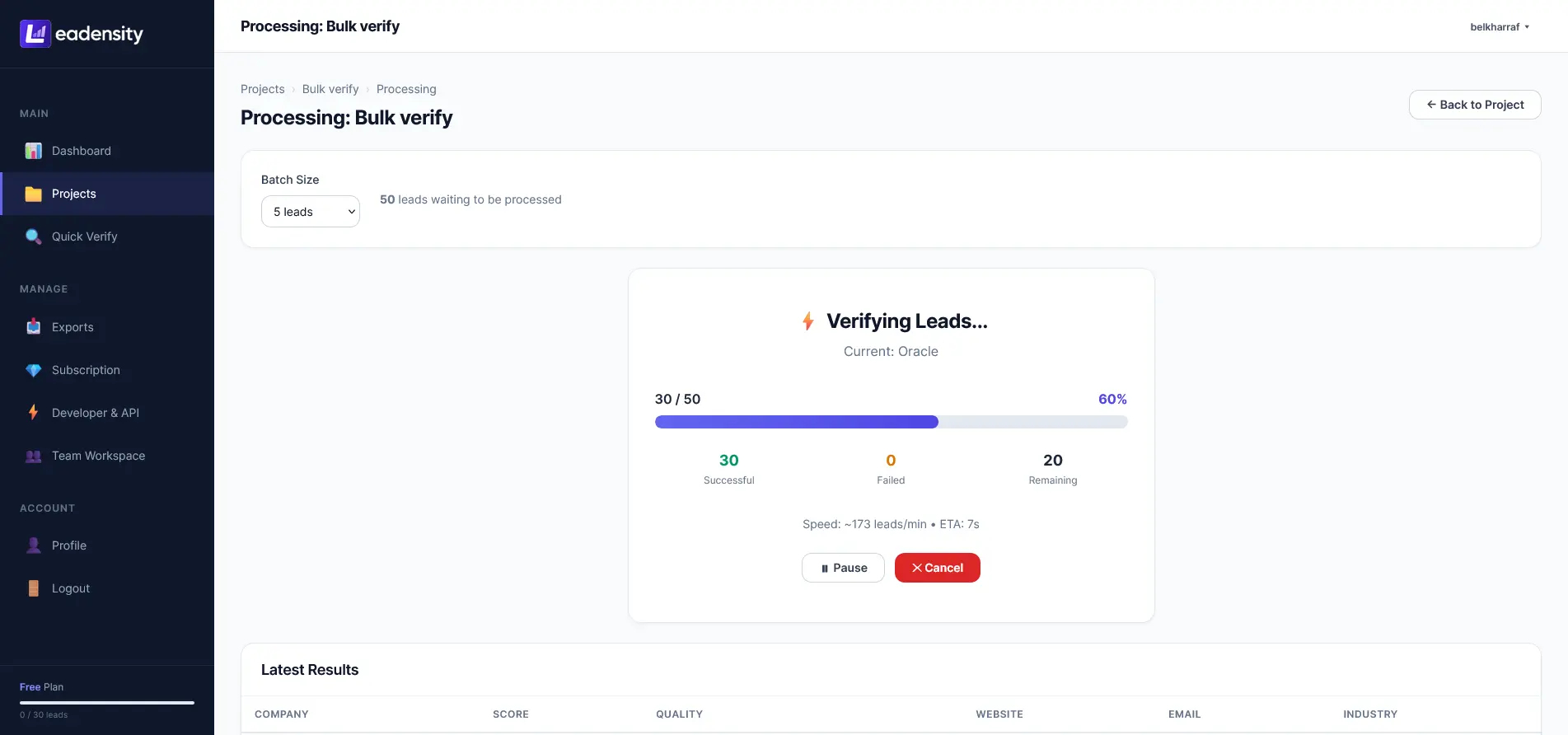
Leadensity eliminates this architectural bottleneck through an asynchronous, browser-controlled micro-batch processing engine:
- Flexible Delimiter and Encoding Ingestion: The client-side parser auto-detects column separators (commas, semicolons, tabs, or pipes), normalizes differing carriage returns (CRLF, LF, CR), and strips UTF-8 byte-order marks (BOM) automatically.
- Intelligent Column Mapping: The system automatically recognizes variations of core fields such as Email, Website Domain, Company Name, Telephone, and Prospect Name, allowing custom user column overrides.
- Micro-Batch AJAX Execution Loop: Rather than forcing the server to evaluate thousands of DNS and HTTP requests simultaneously, the browser orchestrates controlled micro-batches (10 to 25 leads per call). This design works cleanly on standard web servers without exceeding execution time limits.
- Resilient State Controls: Operators can pause, resume, or cancel batch executions in real time. If a temporary network interruption occurs, the engine pauses safely and resumes from the exact record index without duplicating work.
- Clean CSV Export Engine: Once verification completes, users export segmented CSV spreadsheets filtered exclusively by Tier 1 (Excellent) and Tier 2 (Good) leads, leaving scrubbed and invalid records behind.
9. Five Costly Lead Verification Mistakes Outbound Teams Make in 2026
Even seasoned outbound growth organizations make foundational mistakes in list qualification that harm sender reputation and inflate pipeline costs. Review these five common errors to optimize your verification workflow:
Mistake 1: Treating Catch-All Mailboxes as Binary Deliverable Records
Many outbound campaigns fail because teams assume that if an email cleaning tool returns "deliverable" on a catch-all domain, the lead is completely safe. As explained earlier, catch-all domains accept all inbound traffic at the edge before internal mail servers route or discard invalid mailboxes. Teams should segment catch-all records into a dedicated secondary campaign with lower daily sending velocity, rather than blasting them alongside Tier 1 verified corporate inboxes.
Mistake 2: Neglecting Domain Age, DNS TTLs, and Infrastructure Shifts
DNS records are not static. Companies routinely switch mail providers, migrate from on-premise Exchange to Google Workspace, or update their MX priority hosts. Relying on contact lists verified two or three months ago guarantees an elevated bounce rate. Fresh outbound campaigns require list verification conducted within 72 hours of sending.
Mistake 3: Firing High-Volume Outbound Campaigns Without Inbox Warm-Up Ramps
Having clean data is the foundation, but delivering 500 emails per day from a fresh domain that was registered last week will trigger automated anti-spam flags regardless of email validity. Pair Leadensity verified Tier 1 lists with gradual sending ramps, automated inbox warm-up protocols, and strict sending caps (30 to 50 outbound emails per day per mailbox).
Mistake 4: Failing to Deduplicate Across Multi-Field Identifiers
Simple de-duplication based purely on email addresses leaves massive redundancies. If two SDRs scrape the same company, one might target john@acme.com and another john.doe@acme.com, or target different executives using identical corporate telephone numbers. Robust verification engines cross-reference domain names, corporate phone numbers, and physical street addresses to prevent multiple reps from contacting the same account simultaneously.
Mistake 5: Overlooking Tech Stack and Industry Alignment in Prospect Scoring
A lead can be 100% technically deliverable yet completely irrelevant to your solution. If your B2B SaaS integrates exclusively with WordPress and WooCommerce, contacting a verified CTO whose website runs on Webflow or Magento represents wasted sales energy. Qualified outbound lists must combine technical deliverability with technology fingerprinting to verify real buying intent.
10. Real-Time API Gating and Webhook CRM Synchronization
While periodic bulk cleaning protects outbound prospecting lists, sustainable data hygiene requires real-time validation at the point of capture. Gating inbound demo forms, signup flows, and webhooks prevents contaminated data from entering your CRM in the first place.
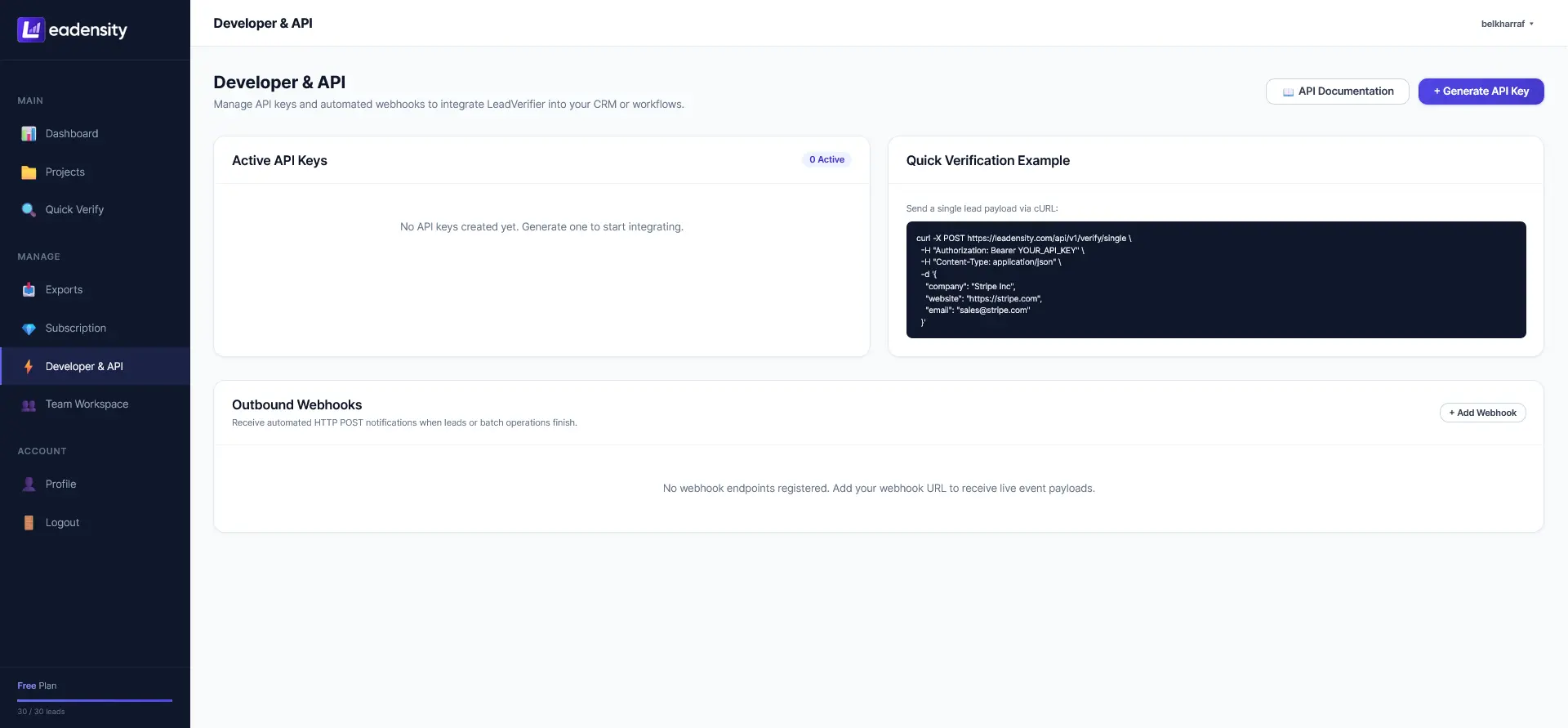
Leadensity provides a dedicated REST API v1 endpoint that allows engineering teams to validate prospect records programmatically with sub-second response times. Using secure API keys and rate-limiting headers, developers integrate verification into custom lead forms, HubSpot workflows, Zapier zaps, and backend sign-up controllers.
POST /api/v1/verify HTTP/1.1
Host: leadensity.com
Authorization: Bearer lv_live_948fbc20e18247ca810f
Content-Type: application/json

{
  "email": "alex.morgan@acmesoftware.io",
  "website": "https://acmesoftware.io",
  "company": "Acme Software"
}

HTTP/1.1 200 OK
Content-Type: application/json

{
  "status": "success",
  "score": 94,
  "tier": "excellent",
  "deliverability": {
    "is_valid_format": true,
    "has_mx_records": true,
    "is_disposable": false,
    "is_consumer_webmail": false
  },
  "website_health": {
    "is_reachable": true,
    "ssl_valid": true,
    "status_code": 200
  },
  "technology": ["WordPress", "Next.js", "Google Analytics 4", "Stripe"],
  "industry": "Software & Technology"
}
When inbound leads register on your landing pages, webhook events trigger background enrichment pipelines. This ensures that outbound sales representatives receive immediate notifications containing technology footprints, deliverability scores, and customized pitch angles before making their initial follow-up contact.
11. Verification Approaches Compared: Syntax vs. Scrapers vs. Leadensity
To understand why legacy scrubbers fail in modern high-volume sales environments, consider this architectural comparison across common verification methodologies:
| Verification Capability | Basic Regex Checks | Standard Email Cleaners | Leadensity 10-Point Platform |
|---|---|---|---|
| Syntax & Domain Formatting | Basic regex only | Full RFC parsing | Full RFC 5322 & RFC 822 parsing |
| DNS Infrastructure (MX, A, TXT) | None | MX record check | Comprehensive A, AAAA, MX, TXT checks |
| Website Health & SSL Security | None | None | HTTP/HTTPS status, SSL validity, redirects |
| Technology Detection (CMS, Pixels) | None | None | Detects 20+ CMS, frameworks, analytics |
| Industry Classification | None | None | Weighted classification across 27 verticals |
| In-Browser AI Neural Analysis | None | None | Client-side WebGPU/WASM neural summaries |
| Batch Upload Timeout Immunity | Fails on big files | Frequent 504 timeouts | Browser-controlled micro-batch AJAX loops |
Integrate real-time prospect validation and technology fingerprinting directly into your forms, web apps, and outbound marketing pipelines.
12. Step-by-Step SOP for SDRs, Growth Teams, and Agencies
To systematically enforce list verification across your organization, adopt this four-step Standard Operating Procedure (SOP) before launching any new sales campaign:
Phase 1: Extraction and Initial De-Duplication
Export your target contact list from your scraping tool, database provider, or event attendee directory. Before uploading to any sending platform, run an internal de-duplication check matching against previously contacted domains, existing open deals, and unsubscribed records.
Phase 2: Bulk Verification Ingestion
Import your raw CSV into Leadensity via the Bulk Verify module. Verify that the column mapper accurately assigns Email, Website, Company Name, and Contact Person fields. Start the browser batch verification process, allowing the micro-batch loop to validate DNS records, test HTTP/HTTPS reachability, confirm SSL encryption, and fingerprint software frameworks.
Phase 3: Lead Scoring Segmentation
Filter your verified project list by quality score:
- Tier 1 (85-100) Prospects: Dispatch immediately into high-touch cold email and cold calling sequences. Personalize opening lines using identified technology stacks and AI-generated pitch angles.
- Tier 2 (70-84) Prospects: Enroll in automated, scaled drip sequences. Monitor deliverability and engagement metrics carefully.
- Tier 3 (50-69) Prospects: Assign to junior SDRs or research assistants for manual mailbox re-checks and alternative contact discovery.
- Tier 4 (0-49) Prospects: Isolate and purge immediately. Under no circumstances should cold emails be transmitted to Tier 4 records.
Phase 4: Feedback Loop and CRM Synchronization
Export your verified Tier 1 and Tier 2 records directly to your outbound sales platform (such as Instantly, Smartlead, Outreach, or HubSpot). Configure webhook alerts to flag newly discovered corporate changes, domain expirations, or tech stack updates back to your core customer database.
13. Frequently Asked Questions
What is the acceptable bounce rate for B2B cold outreach in 2026?
The industry benchmark for cold outbound deliverability is maintaining hard bounce rates strictly below 2%. In 2026, leading mail providers such as Google Workspace and Microsoft 365 enforce aggressive spam throttling if your overall bounce and spam complaint rates exceed critical thresholds. Consistently exceeding a 2% bounce rate permanently damages your sending domain reputation and causes outbound emails to bypass primary inboxes entirely.
How does technology fingerprinting improve outbound sales conversion?
Technology fingerprinting identifies the specific software platforms, CMS engines, analytics tools, and marketing scripts running on a prospect website. This intelligence allows sales teams to craft context-rich, highly targeted messaging. For instance, an agency selling Shopify optimization services can filter exclusively for Shopify-powered e-commerce stores, while a security vendor can target websites lacking valid SSL certificates or modern security headers.
Why do conventional bulk verification tools experience server timeout errors?
Legacy verification services attempt to process tens of thousands of external DNS and HTTP checks inside a single server-side web request. Because web servers and PHP runtimes enforce strict execution time limits (often 30 to 60 seconds), long-running batches terminate prematurely with 504 Gateway Timeout errors. Leadensity solves this problem by utilizing client-side browser AJAX loops that divide large files into manageable micro-batches of 10 to 25 records, processing millions of leads smoothly without timing out.
How does in-browser local AI verification reduce SaaS operating expenses?
Traditional AI lead enrichment tools send prospect records to commercial third-party language model APIs, accumulating costly per-token fees that escalate rapidly when qualifying thousands of leads. Leadensity executes neural network inference locally inside the user web browser utilizing SmolLM2-360M-Instruct via WebGPU and WebAssembly (WASM). This provides instantaneous lead summaries, risk flags, and sales pitch angles with zero token costs and complete data privacy.
Can lead verification prevent legal compliance and TCPA violations?
Yes. Rigorous multi-point lead verification identifies disconnected corporate numbers, flags mobile versus landline carriers, detects spam traps, and verifies genuine corporate business domains. Validating contact credentials before dialing or messaging prevents sales teams from inadvertently contacting unverified phone numbers or harvesting toxic compliance honeypots.
What is the operational difference between hard bounces and soft bounces?
A hard bounce represents a permanent delivery failure caused by an invalid, non-existent, or blocked email address (such as SMTP code 550 User Unknown). Hard bounces must be pruned immediately. A soft bounce indicates a temporary delivery obstacle (such as a full recipient mailbox quota, temporary server downtime, or a message size limit exceeded). While soft bounces can be retried once or twice after a cooling period, recurring soft bounces should be treated as hard failures and removed to safeguard sender scoring.
How frequently should sales teams re-verify their existing CRM database?
Given that B2B data degrades by approximately 30% per year, organizations should execute a comprehensive database scrub every 60 to 90 days. For dynamic outbound sales development teams cycling through thousands of new prospects, verification must be performed immediately prior to sequence enrollment to ensure zero decay between list acquisition and initial contact.
14. Final Verdict: Is Leadensity Right for Your Sales Pipeline?
Target Audience: High-velocity B2B sales teams, growth marketing agencies, outbound SDRs, and software developers who require comprehensive lead verification, technology detection, and deliverability protection without experiencing server timeouts or incurring third-party AI token fees.
Leadensity establishes a modern standard for B2B data verification. By uniting a 10-point technical validation engine with in-browser local AI intelligence, automated tech stack fingerprinting, and resilient micro-batch CSV processing, the platform addresses both deliverability defense and sales relevance in a unified system. Teams seeking to protect their domain health, boost email open rates, and arm sales reps with actionable conversion hooks will find Leadensity an indispensable growth asset.
Verify Your Leads and Defend Your Domain Deliverability
Eliminate hard bounces, catch-all traps, and invalid prospects. Run your lists through Leadensity 10-point verification engine before launching your next campaign.
Get Leadensity →Instant CSV list uploads. Comprehensive REST API and webhooks integration support.