
Top UpLead Alternatives for B2B Lead Verification & Enrichment in 2026
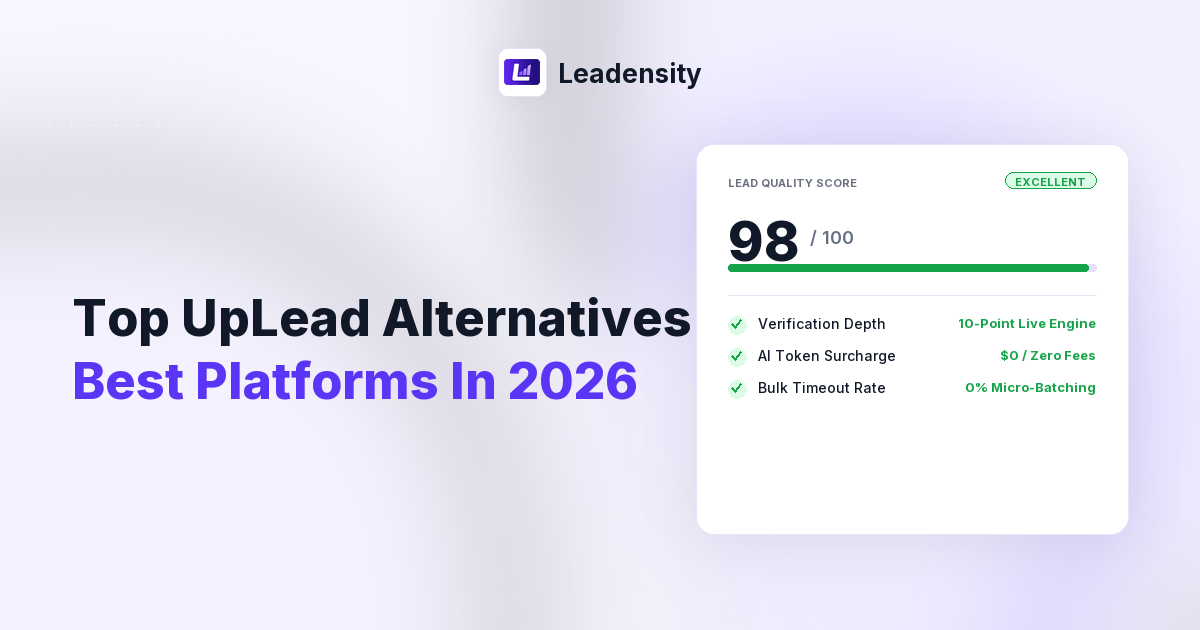
Choosing the right B2B lead verification and data enrichment platform is one of the most critical decisions for modern revenue operations and growth marketing teams. For years, UpLead served as a popular contact database for outbound sales development representatives seeking direct dials and corporate emails. However, as the 2026 sales landscape shifted toward strict mailbox deliverability rules enforced by Google Workspace and Microsoft 365, revenue teams encountered severe structural limitations in traditional static databases. High monthly credit costs, rigid contract locks, superficial single-ping verification, and the absence of native technographic stack detection have prompted sales leaders to search for modern UpLead alternatives. Today, high-growth outbound engines require more than a cached spreadsheet of contact records; they demand live 10-point technical socket verification, deep web infrastructure auditing, and intelligent lead qualification that eliminates third-party AI token fees. In this comprehensive 2026 guide, we evaluate the top UpLead competitors, compare architectural trade-offs, and help you select the ideal lead intelligence platform for your outbound sales stack.
Table of Contents
- 1. Why Sales Teams Are Moving Beyond UpLead in 2026
- 2. The 5 Essential Pillars of Modern Lead Intelligence Platforms
- 3. Platform Review 1: UpLead (Strengths, Weaknesses, and Pricing)
- 4. Platform Review 2: Clay (Strengths, Weaknesses, and The Token Trap)
- 5. Platform Review 3: LeadProsper (Strengths, Weaknesses, and Routing Limits)
- 6. Platform Review 4: Leadensity (The Unified Deliverability & Local AI Alternative)
- 7. Head-to-Head Feature Comparison Matrix
- 8. Total Cost of Ownership (TCO) Analysis: Credits vs. Unlimited SaaS
- 9. Catch-All Resolution: Why Standard Verification Falls Short
- 10. Step-by-Step Migration SOP: Switching from UpLead to Modern Infrastructure
- 11. Frequently Asked Questions (FAQ)
- 12. Final Verdict and Strategic Recommendation
1. Why Sales Teams Are Moving Beyond UpLead in 2026
UpLead built a strong reputation around its 95% data accuracy guarantee and real-time verification feature. However, as the outbound prospecting ecosystem matured, sales development teams began experiencing friction with several inherent constraints:
- Restrictive Credit-Based Billing: UpLead prices its software on strict monthly credit quotas (e.g., $99/mo for 170 credits, or $199/mo for 400 credits). When high-growth outbound teams need to cleanse, verify, and enrich 10,000 to 50,000 prospect records per month, credit-based models become prohibitively expensive, exceeding $1,500 to $3,000 every billing cycle.
- Superficial Verification Depth: While UpLead verifies email syntax and basic SMTP status upon credit download, it lacks deep 10-point technical verification. It does not perform live web server HTTP health checks, SSL certificate chain validation, or multi-probe latency profiling to resolve enterprise catch-all mailboxes.
- The 30% Annual Static Data Decay: Like all centralized contact databases (including ZoomInfo and Apollo), contact data deteriorates at a measured rate of 2.5% per month. When employees change jobs or companies reconfigure mail servers, static directories fall out of sync. Modern teams prefer bringing their own scraped lists or real-time event attendee datasets and running live verification on demand.
- Absence of In-Browser Local AI: UpLead offers zero native AI personalization or sales pitch synthesis. Sales reps must export data and pay for secondary AI tools or external OpenAI API credits to draft tailored outreach hooks.
2. The 5 Essential Pillars of Modern Lead Intelligence Platforms
When evaluating alternatives to UpLead in 2026, revenue operations leaders must measure platforms against five core technical capabilities:
1. Live 10-Point Technical Socket Verification
The platform must connect directly to the target domain mail exchange host via TCP port 25, verifying DNS MX, SPF, DKIM, and SMTP mailbox existence in real time without relying on cached database tags.
2. Automated Technographic Fingerprinting
The ability to passively crawl corporate web servers and identify installed software ecosystems (Stripe, Shopify, HubSpot, Salesforce, Cloudflare, Google Analytics 4) to enable competitive displacement sales hooks.
3. Zero-Token AI Intelligence
Instead of passing data to third-party commercial APIs that charge expensive per-token fees, modern platforms execute neural inference locally in the browser (`SmolLM2-360M-Instruct`) via WebGPU/WASM with $0 in API expenses.
4. Timeout-Free Bulk Micro-Batching
Eliminating 504 Gateway Timeouts by streaming large CSV uploads into asynchronous browser micro-batches of 10 to 25 leads per burst, processing files containing 50,000+ records smoothly.
5. Comprehensive Developer REST API & Webhooks
High-throughput programmable endpoints allowing revenue engineers to gate inbound form submissions and sync quality scores directly to CRMs in real time.
3. Platform Review 1: UpLead (Strengths, Weaknesses, and Pricing)
UpLead remains a respectable choice for sales representatives who require a pre-packaged B2B database search engine. Users can filter by company size, job title, industry, and geography, downloading contacts directly into their CRM.
UpLead Core Specifications
Best For: Small sales teams needing simple database filtering without technical customization.
- Strengths: Built-in search directory of 150M+ contacts, Chrome extension for LinkedIn, direct integration with Salesforce and HubSpot.
- Weaknesses: Restrictive monthly credit quotas, no bring-your-own-list bulk CSV verification engine, no live web server SSL health auditing, no native AI personalization.
- Pricing Structure: Essentials: $99/mo (170 credits = $0.58/lead); Plus: $199/mo (400 credits = $0.50/lead); Professional: $399/mo (1,000 credits = $0.40/lead). Additional credits cost $0.50 each.
4. Platform Review 2: Clay (Strengths, Weaknesses, and The Token Trap)
Clay has gained substantial traction among growth marketing engineers for its flexible spreadsheet-style interface and multi-provider data waterfall integrations (connecting Apollo, Hunter, Dropcontact, and LinkedIn scrapers).
Clay Core Specifications
Best For: Advanced technical growth teams building complex multi-vendor waterfall workflows.
- Strengths: 50+ data provider integrations, powerful AI prompt columns, customizable table views.
- Weaknesses: The “Token Trap”: every AI formula and enrichment query burns external credits. Pricing quickly compounds ($149 to $800+/mo), steep learning curve, and complex credit math.
- Pricing Structure: Starter: $149/mo (2,000 credits); Explorer: $349/mo (10,000 credits); Pro: $800/mo. Teams frequently spend an additional $500+/mo on OpenAI API tokens.
5. Platform Review 3: LeadProsper (Strengths, Weaknesses, and Routing Limits)
LeadProsper is specialized for lead generation agencies and affiliates focused on inbound lead distribution, ping-post campaigns, and TCPA compliance tracking rather than outbound SDR prospecting.
LeadProsper Core Specifications
Best For: Lead brokers and pay-per-lead affiliate agencies distributing leads to multiple buyers.
- Strengths: Real-time ping-post routing, custom field mapping, Jornaya and TrustedForm TCPA compliance integration.
- Weaknesses: Not designed for outbound sales development, no native technographic web fingerprinting, complex rule builder.
- Pricing Structure: Usage-based pricing starting at $0.01 to $0.05 per processed inbound ping.
6. Platform Review 4: Leadensity (The Unified Deliverability & Local AI Alternative)
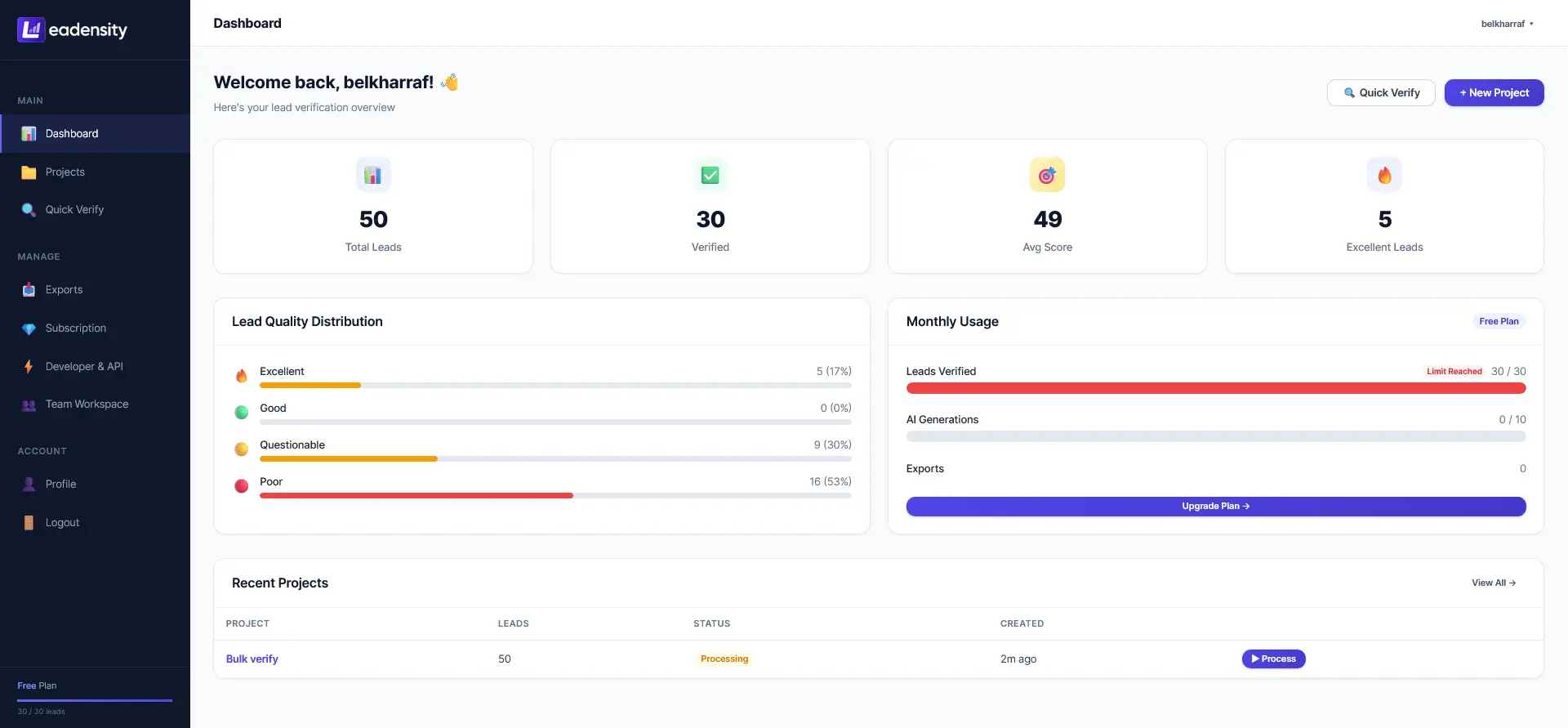
Leadensity represents the modern generation of B2B lead intelligence, uniting deep 10-point technical verification, automated technographic detection, and in-browser local AI execution into a single, high-velocity workspace.
Leadensity Core Specifications
Best For: High-velocity outbound sales teams, growth marketing agencies, and SaaS developers who demand deep deliverability defense, technographic intelligence, and zero AI token fees.
- Live 10-Point Technical Verification: Full TCP socket handshakes, DNS MX/SPF/DMARC audits, web server HTTP 200 checks, and SSL certificate chain validation.
- Zero-Token Local AI (SmolLM2-360M): Neural synthesis executes client-side in the browser via WebGPU and WebAssembly. Instant summaries and sales pitch angles with $0.00 in API token expenses.
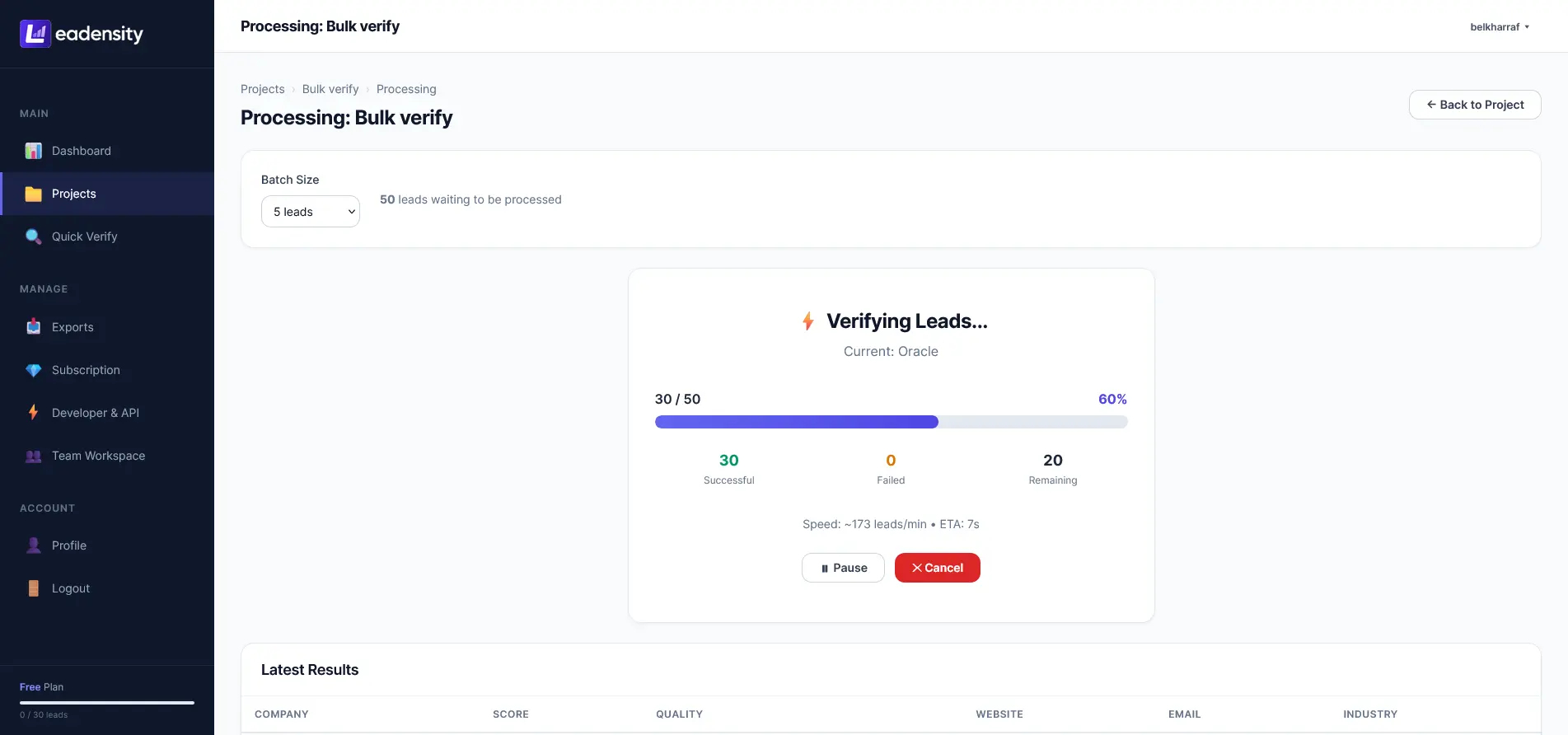
- Timeout-Free Micro-Batching: Browser AJAX streaming processes lists of 50,000+ leads without ever triggering 504 Gateway Timeouts.
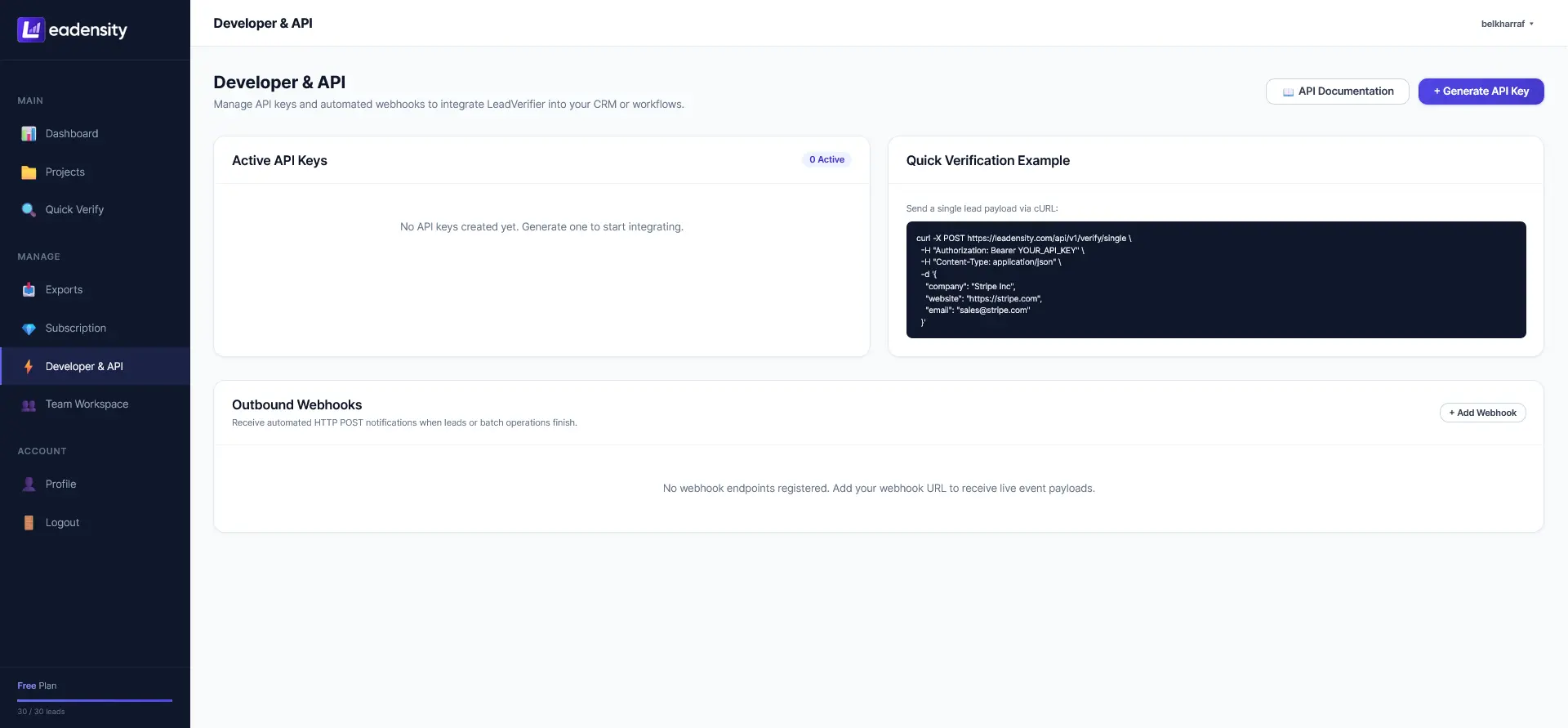
- Developer REST API & Webhooks: Clean programmatic endpoints (
POST /api/v1/verify) for real-time form gating and CRM sync. - Pricing Structure: Predictable flat SaaS plans with massive list allowances and zero per-token AI surcharges.
7. Head-to-Head Feature Comparison Matrix
To evaluate the architectural differences between UpLead, Clay, LeadProsper, and Leadensity, review the comprehensive comparison table below:
8. Total Cost of Ownership (TCO) Analysis: Credits vs. Unlimited SaaS
To understand the financial implications of selecting a lead verification platform, let us model the Total Cost of Ownership (TCO) for a company processing 25,000 leads per month over an annual cycle:
Annual Cost Simulation: Processing 25,000 Leads/Month (300,000 Leads/Year)
- UpLead (Credit-Based): At an average enterprise rate of $0.35 per credit, downloading and verifying 300,000 contacts costs $105,000 annually.
- Clay (Credits + External AI Tokens): Enterprise plan ($800/mo) + estimated 300M tokens across third-party OpenAI/Claude APIs ($2,400/yr) = $12,000 to $18,000 annually.
- Leadensity (Unified Engine with In-Browser AI): Flat SaaS pricing with zero per-token surcharges and zero per-credit penalties = Under $2,400 annually (saving up to 80% to 95% in software overhead).
9. Catch-All Resolution: Why Standard Verification Falls Short
One of the primary drivers behind teams abandoning UpLead is the mishandling of catch-all email domains. In modern B2B sales, over 40% of enterprise corporate domains are configured to accept all incoming emails at the edge. When UpLead or basic syntax scrubbers encounter a catch-all server, they label the contact as “Risky / Unknown.”
Sales teams are left with an impossible choice: delete 40% of their addressable market, or send blindly and suffer severe deliverability penalties under Google and Yahoo 2026 guidelines (<0.3% spam rate). Leadensity resolves catch-alls through multi-probe latency profiling, secondary DNS record checks, and website SSL verification, converting ambiguous catch-alls into actionable Tier 1 (Safe) vs. Tier 3 (Toxic) categories.
10. Step-by-Step Migration SOP: Switching from UpLead to Modern Infrastructure
Migrating from UpLead to Leadensity is straightforward and requires zero technical downtime:
- Export Your Existing Contact Databases: Export your prospect lists and historical lead files from UpLead or your current CRM as standard CSV files.
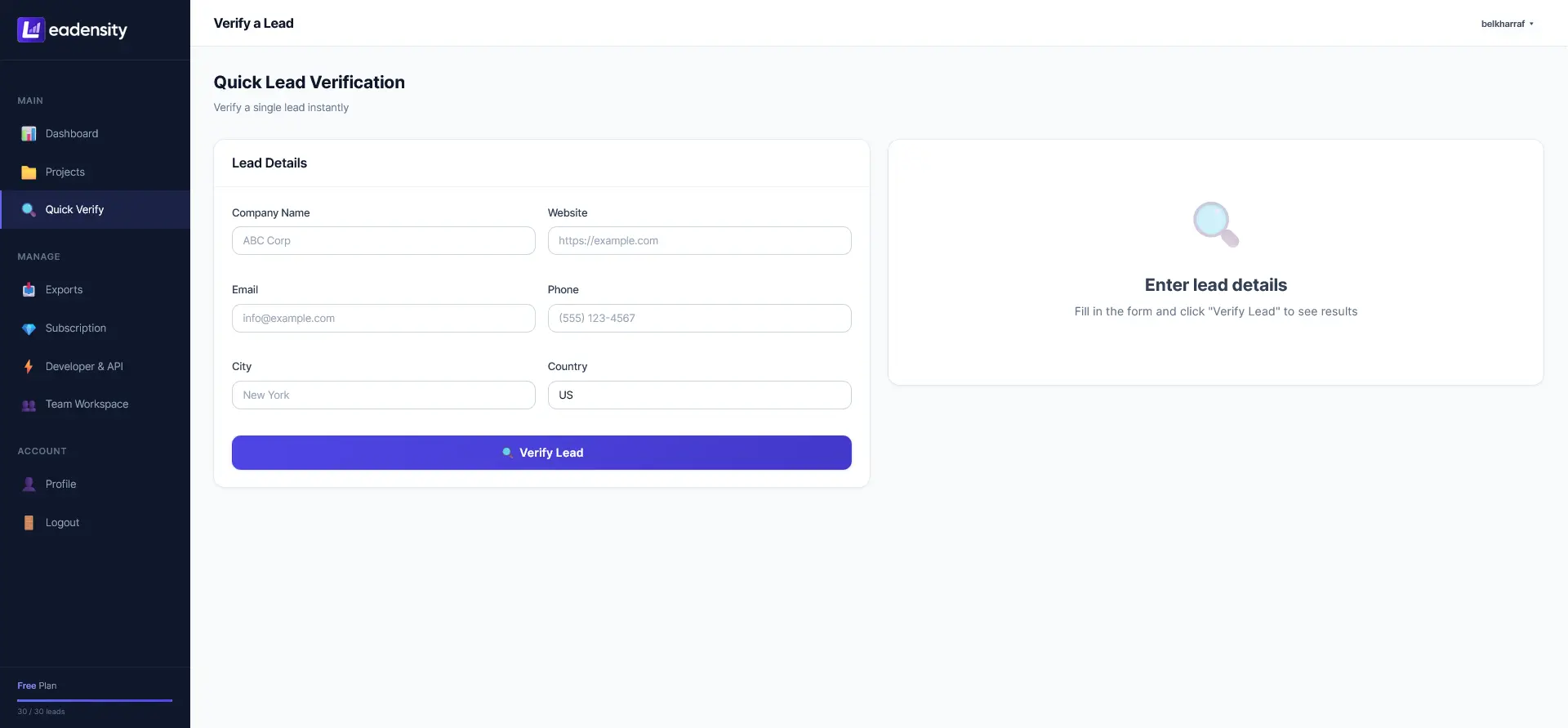
- Import into Leadensity Bulk Verifier: Upload your CSV into Leadensity. Use the smart column mapper to align first name, email, company domain, and job title fields.
- Run 10-Point Technical Cleansing: Execute the verification engine. Leadensity inspects DNS, MX, SMTP sockets, web server health, and software stack signatures in parallel.
- Synthesize with In-Browser AI: Enable local AI synthesis to extract company summaries and customized conversation hooks with zero external token fees.
- Export Prioritized Tiers: Filter records by Lead Quality Score (≥90 for Tier 1) and import clean, deliverability-guaranteed leads into your sales sequencing platform.
11. Frequently Asked Questions (FAQ)
Is Leadensity a direct contact database like UpLead?
Leadensity is a live lead verification, technographic enrichment, and AI scoring platform. Rather than selling static, pre-packaged contact lists that decay by 30% annually, Leadensity verifies, enriches, and qualifies prospect data in real time, whether sourced from web forms, event attendee lists, or custom scrapers.
How does Leadensity eliminate AI token costs?
Unlike platforms like Clay that proxy data to commercial cloud language model APIs (charging ongoing per-token fees), Leadensity executes local neural inference directly in your browser using SmolLM2-360M-Instruct via WebGPU and WebAssembly. You get instant lead summaries and pitch angles with zero third-party token bills.
Can Leadensity handle massive lists without server timeout errors?
Yes. Traditional tools crash on large files because server-side PHP requests encounter 30-second gateway caps. Leadensity client-side AJAX micro-batching streams large lists in bursts of 10 to 25 leads, processing 50,000+ records smoothly without 504 Gateway Timeouts.
How does Leadensity protect sender reputation under 2026 email rules?
Google Workspace and Yahoo Mail enforce strict spam complaint thresholds (<0.3%) and penalize bounce rates above 2%. Leadensity 10-point technical engine validates SMTP sockets, identifies spam traps, and audits DNS records to guarantee bounce rates remain safely below 1.5%.
12. Final Verdict and Strategic Recommendation
Strategic Recommendation: Choose Live Verification over Static Credits
While UpLead served an important role in the early era of B2B prospecting, modern outbound sales teams require deeper technical deliverability defense, technographic stack detection, and zero-token AI qualification.
For teams seeking to scale outbound pipeline, eliminate 504 Gateway Timeouts, and defend their domain reputation under strict 2026 email guidelines, Leadensity delivers the most advanced, cost-effective lead intelligence platform on the market.
Platform Selection Summary:
- Choose UpLead: If you only need a basic contact search directory and do not mind paying per-credit fees.
- Choose Clay: If you are building complex multi-vendor waterfall tables and have budget for ongoing AI token surcharges.
- Choose LeadProsper: If you operate an affiliate lead brokerage distributing inbound pings.
- Choose Leadensity: If you want live 10-point technical verification, native technographics, zero-token AI scoring, and timeout-free bulk processing.
Upgrade to Modern Lead Intelligence Today
Ditch restrictive credit models and stale static databases. Verify deliverability, detect tech stacks, and score prospects with Leadensity 10-point engine.
Start Verifying Leads with Leadensity →Instant CSV list uploads. Complete WebGPU local neural execution. REST API and Webhooks included.